Study skills
What is active recall?
Quick answer
Active recall means testing yourself by pulling information out of your memory, instead of rereading it. It is one of the best-supported ways to revise.
In one sentence
Active recall is revising by asking yourself questions and answering from memory, rather than just reading your notes again.
Explained
Every time you pull a fact out of your memory, you make it easier to find next time. Psychologists call this retrieval practice, or the testing effect, and it has been studied for over a hundred years in labs and classrooms. In many experiments, students who tested themselves remembered more a week later than students who spent the same time rereading.
Rereading and highlighting feel productive because the page looks familiar. But familiar is not the same as remembered. In an exam, the page is not in front of you; you have to recall it. Active recall practises exactly that.
Self-testing often feels harder and slower than rereading, and you will get things wrong. That is normal, and it is part of why it works. The key is to check your answers straight after, so you fix mistakes instead of remembering them.
Active recall works best when combined with spaced repetition: testing yourself on the same material again after a few days, then after a week. It is a strong study habit, not a magic trick; you still need to understand the topic first. The UK's Education Endowment Foundation has reviewed the evidence on retrieval and spacing in schools, and you can read its summary of the review.
 notebook
 pencil
 book
book clock
clock
Examples
- Brain dump: close your notes and write everything you know about photosynthesis in five minutes. Then open the notes and fill gaps in a different colour.
- Flashcards: question on the front, answer on the back. Say the answer before you flip.
- Past questions: answer exam questions without notes, then mark them.
- Teach it: explain a topic out loud to a friend, a parent or even a pet, without looking.
- Blank diagram: draw and label the heart or the water cycle from memory.
Common mistakes
- Peeking too early. Give yourself a real try before checking, even if you are unsure.
- Only testing what you already know. Spend most time on the cards and questions you get wrong.
- Not checking answers. Testing without feedback can lock in mistakes.
- Cramming all the tests in one night. Spread them out over days and weeks.
Quick quiz
Active recall
Check what you know with 4 quick questions.
Question 1 of 4
Which of these is active recall?
Practise it
Try it
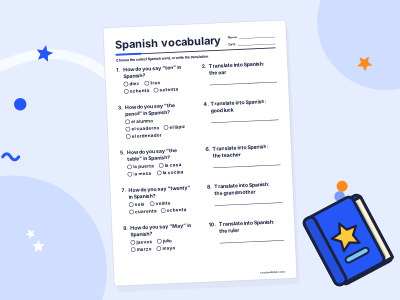
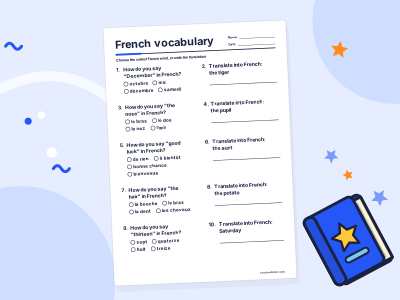
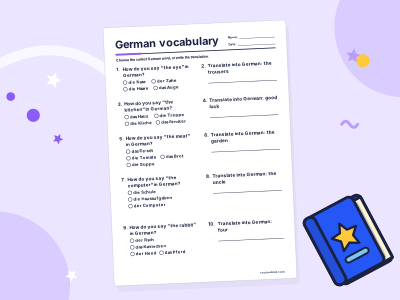
Flashcards to test yourself
For grown-ups
Related topics
Spaced repetition
Spaced repetition means reviewing what you have learned several times with gaps in between, instead of cramming it all at once. The gaps help memories last longer.
Flashcards
Flashcards are small cards with a question on one side and the answer on the other. They work best when you answer from memory before you flip.
Exam technique
Exam technique is the set of skills for answering the paper well on the day, such as reading questions carefully, using marks to plan time and checking your work.
Revision timetable
A revision timetable is a plan of what to revise and when. Good ones use short sessions, mix subjects, revisit topics after gaps and leave time for rest.
Note-taking
Good notes are short, in your own words and organised so you can test yourself later. Methods like Cornell notes build in questions and a summary.
Growth mindset
A growth mindset is the belief that abilities can improve with practice, good strategies and help. A fixed mindset is the belief that you either have a talent or you don't.