Maths
How do you work out speed, distance and time?
Quick answer
Speed is distance divided by time. So speed = distance ÷ time, distance = speed × time, and time = distance ÷ speed. A car that goes 150 km in 2 hours travels at 75 km/h.


In one sentence
Speed tells you how far something goes in one unit of time, and the three quantities speed, distance and time are linked by one simple formula.
Explained
If you walk 4 kilometres in 1 hour, your speed is 4 kilometres per hour, written 4 km/h. If you go twice as far in the same time, you are going twice as fast. This is the main idea:
speed = distance ÷ time
You can rearrange the formula to find the other two:
- distance = speed × time
- time = distance ÷ speed
A handy memory aid is a triangle with D at the top and S and T at the bottom. Cover the one you want and read what is left: cover D and you see S × T; cover S and you see D ÷ T; cover T and you see D ÷ S.
 car
 clock
 train
Examples:
- Find speed. A car travels 150 km in 2 hours. Speed = 150 ÷ 2 = 75 km/h.
- Find distance. A bus goes at 60 km/h for 3 hours. Distance = 60 × 3 = 180 km.
- Find time. A cyclist rides 45 km at 15 km/h. Time = 45 ÷ 15 = 3 hours.
Keep your units consistent. If the speed is in km/h, the time must be in hours and the distance in km. A time of 2 hours 30 minutes is 2.5 hours, not 2.3. To change minutes into a fraction of an hour, divide by 60: 45 minutes is 0.75 hours.
On a real trip, speed changes. The average speed is the total distance ÷ total time, including any stops. For example, 100 km in 2 hours including a break is an average of 50 km/h.
To change km/h to metres per second, divide by 3.6: 36 km/h is 10 m/s. Speed is a ratio of distance to time. It links to forces in science, and you solve it like simple equations.
Examples
| Distance | Time | Speed |
|---|---|---|
| 150 km | 2 h | 75 km/h |
| 30 km | 2 h | 15 km/h |
| 100 m | 20 s | 5 m/s |
| 240 km | 3 h | 80 km/h |
Common mistakes
- Mixing units. Do not divide kilometres by minutes and call it km/h.
- Writing 2 h 30 min as 2.30. It is 2.5 hours.
- Dividing the wrong way round. Check that the answer is sensible: a car cannot travel 2 km/h.
Quick quiz
Speed, distance and time
Check what you know with 4 quick questions.
Question 1 of 4
A cyclist rides 30 km in 2 hours. What is her speed?
Practise it
Try it
Physics and measuring practice
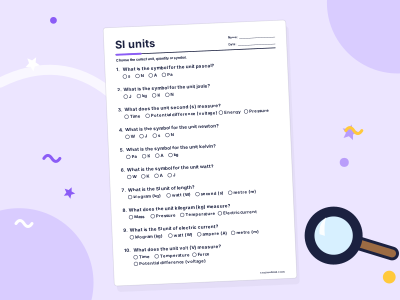
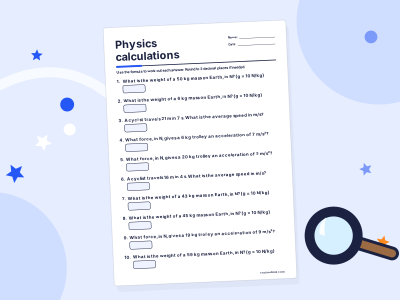
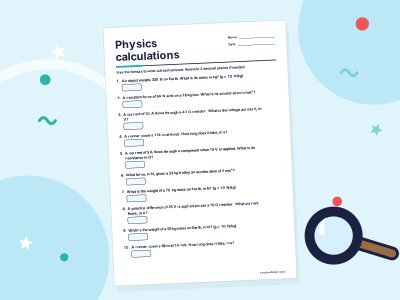
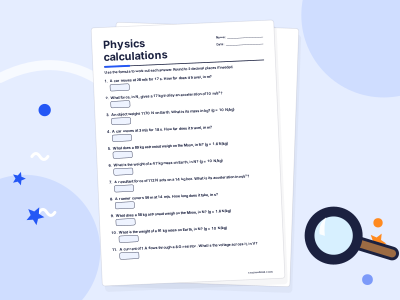
Practise it step by step in a full course: Grade 8 Maths
For grown-ups
Related topics

Forces
A force is a push or a pull. Forces can make things start moving, speed up, slow down, change direction or change shape. They are measured in newtons.

Ratio
A ratio compares two or more amounts, written with a colon. A ratio of 2:3 means for every 2 of one thing there are 3 of the other.

Equations
An equation says two things are equal, using an = sign, like 2x + 1 = 9. Solving it means finding the value of the letter that makes it true, here x = 4.
Acceleration
Acceleration is how quickly velocity changes. a = (v − u) ÷ t, the change in velocity divided by the time taken, measured in metres per second squared (m/s²).

Differentiation (derivatives)
Differentiation finds the rate of change of a function: the gradient of its curve at any point. The power rule says xⁿ differentiates to nxⁿ⁻¹, so x³ becomes 3x².

Direct proportion
Two quantities are in direct proportion when one is always the same multiple of the other, so doubling one doubles the other. The rule is y = kx, where k is the constant of proportionality.