Science
What is a force?
Quick answer
A force is a push or a pull. Forces can make things start moving, speed up, slow down, change direction or change shape. They are measured in newtons.
In one sentence
A force is a push or a pull that can change how something moves or change its shape.
Explained
You use forces all day. You push a door open, pull on your socks, squash play dough and twist a bottle lid. Every one of these is a force.
Forces can:
- make something start moving (kicking a ball)
- make something speed up or slow down (pedalling harder, braking a bike)
- change the direction something moves (heading a football)
- change the shape of something (squeezing a sponge)
Some forces need things to touch. These are contact forces, like pushing, pulling, friction and air resistance. Others work across a gap. These are non-contact forces: gravity, magnetism and static electricity.
Forces usually come in pairs and have a direction. Scientists draw them as arrows: the longer the arrow, the bigger the force.
When forces are balanced, they cancel out. A tug of war where both teams pull equally hard doesn't move. A book on a table is held still because the table pushes up as hard as gravity pulls down. When forces are unbalanced, things change: one team wins and the rope moves.
Forces are measured in newtons (N), named after Isaac Newton. A newton is quite small: holding an apple takes about one newton.

Examples
| Action | Force | What it does |
|---|---|---|
| Kicking a ball | push | starts it moving |
| Catching a ball | push | stops it |
| Opening a drawer | pull | starts it moving |
| A kite on a string | pull from the wind and the string | holds it up |
| Squeezing a stress ball | squash | changes its shape |
Common mistakes
- "Moving things need a force to keep moving." A moving object keeps going unless a force such as friction slows it. On ice, a puck slides a long way.
- "A still object has no forces on it." It has forces, but they are balanced.
- "Heavier things always fall faster." Without air resistance, all objects fall at the same rate. See gravity.
Quick quiz
Forces
Check what you know with 4 quick questions.
Question 1 of 4
What is a force?
Practise it
Try it
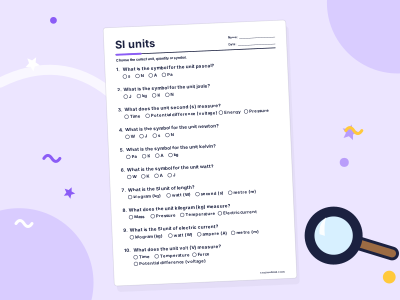
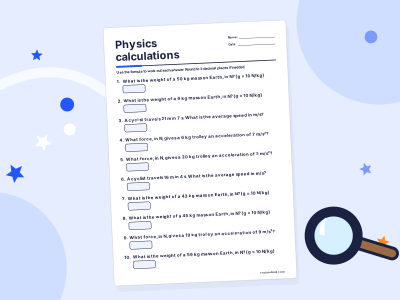
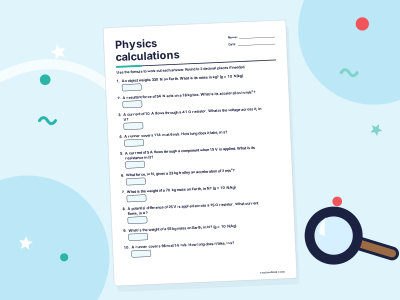
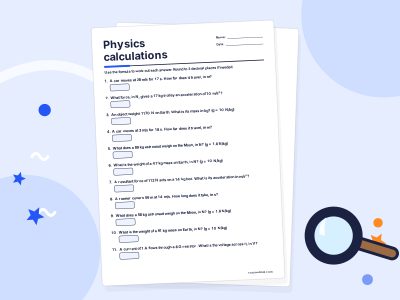
Roll a toy car down a ramp onto carpet, then onto a smooth floor, and measure how far it goes. Then try more physics activities.
Forces and motion activities
For grown-ups
Related topics
Gravity
Gravity is the force that pulls objects towards each other. Earth's gravity pulls everything towards its centre, which is why things fall down and why the Moon orbits Earth.
Friction
Friction is a force that acts when two surfaces rub or slide against each other. It slows things down and turns movement into heat, and it also stops us slipping.
Magnets
A magnet is an object that pulls on certain metals, such as iron, and pushes or pulls on other magnets. Every magnet has a north pole and a south pole.
Sound
Sound is made when something vibrates. The vibrations travel through air, water or solids to our ears. Sound cannot travel through empty space.
Electric circuits
An electric circuit is a complete loop that electricity flows around. A simple circuit has a battery, wires and a component like a bulb. If the loop is broken, the electricity stops.
Electricity
Electricity is the flow of tiny charged particles called electrons through a material. It powers lights, phones and machines, and it can come from batteries or the mains supply.