Maths
What is differentiation in maths, and how do you differentiate?
Quick answer
Differentiation finds the rate of change of a function: the gradient of its curve at any point. The power rule says xⁿ differentiates to nxⁿ⁻¹, so x³ becomes 3x².


In one sentence
Differentiation is the part of calculus that works out how fast something is changing: it gives the gradient of a curve at any point.
Explained
A straight line has the same slope everywhere. A curve does not: y = x² is flat at the bottom and gets steeper and steeper. Differentiation gives a formula for the steepness at every point. That formula is called the derivative.
 rocket
 car
 mountain
The derivative of y with respect to x is written dy/dx (say "dee y by dee x"). If the function is called f, the derivative is f′(x) ("f dash of x" or "f prime of x"). At any point, it equals the gradient of the tangent, the straight line that just touches the curve there.
Where does it come from? Take two points on the curve, x and x + h, and work out the gradient of the line joining them: (f(x + h) − f(x)) ÷ h. Now make h smaller and smaller. The line turns into the tangent. For y = x², the gradient is ((x + h)² − x²) ÷ h = (2xh + h²) ÷ h = 2x + h, and as h shrinks to 0 this becomes 2x. This is called differentiation from first principles.
Nobody does that every time, because a pattern appears. This is the power rule:
If y = xⁿ, then dy/dx = nxⁿ⁻¹
In words: multiply by the power, then take one off the power. x³ becomes 3x², x⁵ becomes 5x⁴. Three more rules let you differentiate any polynomial:
- A number in front stays: 4x³ becomes 4 × 3x² = 12x².
- A constant on its own disappears: 7 becomes 0, because a flat line has gradient 0.
- Sums are done term by term: x² + 5x − 3 becomes 2x + 5.
The power rule works for any power, including negative ones and fractions. To use it, first rewrite roots and fractions as powers: √x = x^(1/2) and 1/x = x⁻¹.
Why does it matter? A derivative is a rate of change, like the speed of a car (the rate distance changes with time) or how fast a population grows. Setting dy/dx = 0 finds the stationary points of a curve, which are usually its maximums and minimums (occasionally a point of inflection, like x = 0 on y = x³), which is how engineers and businesses find the strongest, cheapest or most profitable design. Going backwards, from a derivative to the original function, is integration.
Examples
| Function | Rewrite as powers | Derivative |
|---|---|---|
| y = x³ | — | dy/dx = 3x² |
| y = 5x² | — | dy/dx = 10x |
| y = 4x | — | dy/dx = 4 |
| y = 7 | — | dy/dx = 0 |
| y = x² + 3x − 2 | — | dy/dx = 2x + 3 |
| y = 1/x | y = x⁻¹ | dy/dx = −x⁻² = −1/x² |
| y = √x | y = x^(1/2) | dy/dx = ½x^(−1/2) = 1/(2√x) |
Worked example: find the gradient of y = x² − 4x + 1 at x = 3, and the equation of the tangent there. Differentiate: dy/dx = 2x − 4. At x = 3 the gradient is 2(3) − 4 = 2. The point on the curve is y = 9 − 12 + 1 = −2, so the tangent goes through (3, −2) with gradient 2: y + 2 = 2(x − 3), which is y = 2x − 8.
Common mistakes
- Forgetting to lower the power. The derivative of x³ is 3x², not 3x³. Multiply by the power and take one off.
- Thinking a constant stays. y = x² + 7 differentiates to 2x: the 7 disappears. But 4x differentiates to 4, not 0.
- Getting negative powers wrong. For x⁻², one less than −2 is −3, so the derivative is −2x⁻³, not −2x⁻¹.
- Differentiating a product bit by bit. (x²)(x³) does not differentiate to (2x)(3x²). Multiply out first (x⁵ gives 5x⁴) or use the product rule.
- Putting the number in too early. To find the gradient at x = 3, differentiate first, then substitute. Substituting first gives a constant, whose derivative is always 0.
Step by step
Step by step
- Rewrite as powers of xTurn roots and fractions into powers: √x = x^(1/2), 3/x² = 3x⁻². Multiply out brackets.
- Multiply by the powerFor each term axⁿ, multiply the number in front by n.
- Lower the power by oneThe new power is n − 1. Constants on their own become 0.
- Tidy upWrite the derivative neatly, turning negative powers back into fractions if the question uses them.
- Use itSubstitute an x-value to get the gradient at that point, or set dy/dx = 0 to find stationary points.
To tell a maximum from a minimum, differentiate again to get the second derivative, d²y/dx². If it is positive at the stationary point, it is a minimum; if it is negative, it is a maximum.
Practice questions
Differentiate
Try each one, then check your answer.
- Differentiate y = x⁵.
Show answer
dy/dx = 5x⁴ - Differentiate y = 3x².
Show answer
3 × 2x = 6x - Differentiate y = 7x.
Show answer
7 - Differentiate y = 12.
Show answer
A constant: 0 - Differentiate y = x³ + 4x² − 2x + 9.
Show answer
3x² + 8x − 2 - Differentiate y = 2x⁴ − 5x³.
Show answer
8x³ − 15x² - Differentiate f(x) = 1/x².
Show answer
f(x) = x⁻², so f′(x) = −2x⁻³ = −2/x³ - Differentiate f(x) = √x.
Show answer
f(x) = x^(1/2), so f′(x) = ½x^(−1/2) = 1/(2√x) - Differentiate f(x) = 4x³ − 6/x.
Show answer
f(x) = 4x³ − 6x⁻¹, so f′(x) = 12x² + 6/x² - Differentiate y = (x + 3)².
Show answer
Expand: x² + 6x + 9, so dy/dx = 2x + 6 - Find d²y/dx² for y = x⁴ + 3x².
Show answer
dy/dx = 4x³ + 6x, so d²y/dx² = 12x² + 6 - Find the gradient of y = x³ − 2x at x = 2.
Show answer
dy/dx = 3x² − 2 = 12 − 2 = 10 - Find the equation of the tangent to y = x² + 1 at x = 1.
Show answer
dy/dx = 2x = 2; the point is (1, 2); y − 2 = 2(x − 1), so y = 2x - Find the stationary point of y = x² − 6x + 5 and say what type it is.
Show answer
2x − 6 = 0, x = 3, y = 9 − 18 + 5 = −4: (3, −4), a minimum (d²y/dx² = 2 > 0) - Find the stationary points of y = x³ − 3x.
Show answer
3x² − 3 = 0, x = ±1. d²y/dx² = 6x: (1, −2) is a minimum and (−1, 2) is a maximum - Use the chain rule to differentiate y = (2x + 1)⁵.
Show answer
5(2x + 1)⁴ × 2 = 10(2x + 1)⁴
Word problems
Rates of change in real life
Try each one, then check your answer.
- A stone falls s = 5t² metres in t seconds. How fast is it falling after 3 seconds?
Show answer
ds/dt = 10t = 10 × 3 = 30 m/s - A ball's height is h = 20t − 5t² metres. When is it highest, and how high does it go?
Show answer
dh/dt = 20 − 10t = 0, so t = 2; h = 40 − 20 = 20 m, after 2 seconds - A farmer has 60 m of fence for three sides of a rectangular pen; a wall is the fourth side. The area is A = x(60 − 2x). Find the largest area.
Show answer
A = 60x − 2x², dA/dx = 60 − 4x = 0, x = 15: 450 m² (15 m by 30 m) - The daily profit from selling x cupcakes is P = 4x − 0.02x² dollars. How many cupcakes give the most profit?
Show answer
dP/dx = 4 − 0.04x = 0, x = 100: 100 cupcakes, for $200 profit - An open box is made from a 12 cm square of card by cutting a square of side x from each corner. Its volume is V = x(12 − 2x)². Which x gives the biggest box?
Show answer
dV/dx = (12 − 2x)(12 − 6x) = 0 gives x = 6 (no box) or x = 2: x = 2 cm, volume 128 cm³
Questions people ask
What is differentiation in maths?
It is finding the derivative of a function: a formula for its rate of change, or the gradient of its graph, at every point. In biology, "differentiation" means something else: cells becoming specialised, like stem cells turning into nerve or muscle cells. In teaching, it means adapting lessons for different learners.
What are the rules of differentiation?
Power rule: xⁿ gives nxⁿ⁻¹. Constants give 0 and constant multiples stay. Chain rule: dy/dx = dy/du × du/dx. Product rule: (uv)′ = u′v + uv′. Quotient rule: (u/v)′ = (u′v − uv′)/v².
How do you differentiate from first principles?
Use f′(x) = limit as h → 0 of (f(x + h) − f(x)) ÷ h. Expand f(x + h), cancel, divide by h, then let h become 0. For x³ you get 3x² + 3xh + h², which becomes 3x².
What are the derivatives of sin x, cos x and tan x?
sin x gives cos x, cos x gives −sin x, and tan x gives sec² x (x in radians). Also sec x gives sec x tan x and cot x gives −cosec² x. For the inverses, sin⁻¹x gives 1/√(1 − x²) and tan⁻¹x gives 1/(1 + x²).
How do you differentiate eˣ, aˣ and ln x?
eˣ is its own derivative. aˣ gives aˣ ln a, and ln x gives 1/x. With the chain rule, e^(x²) gives 2x e^(x²).
How is differentiation used in physics?
Velocity is the derivative of displacement with time (v = ds/dt), and acceleration is the derivative of velocity (a = dv/dt). The gradient of a distance–time graph is speed for the same reason.
What is the difference between differentiation and integration?
They are opposites. Differentiation goes from a quantity to its rate of change (distance to speed); integration goes from a rate of change back to the quantity (speed to distance) and finds areas under curves.
Quick quiz
Differentiation (derivatives)
Check what you know with 5 quick questions.
Question 1 of 5
What is the derivative of x⁴?
Practise it
Try it
Practise differentiating polynomials with unlimited questions
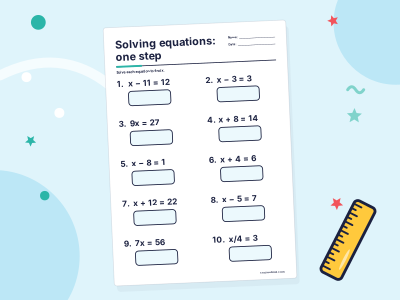
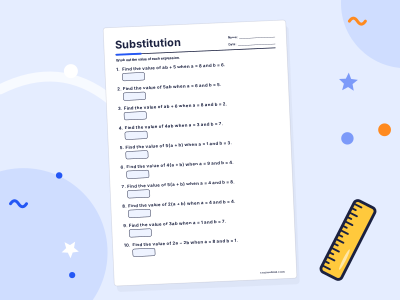
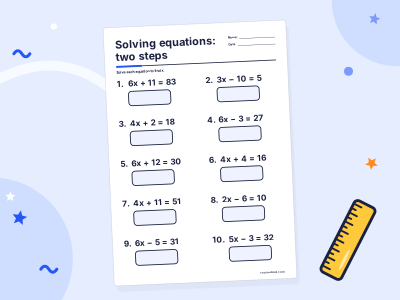
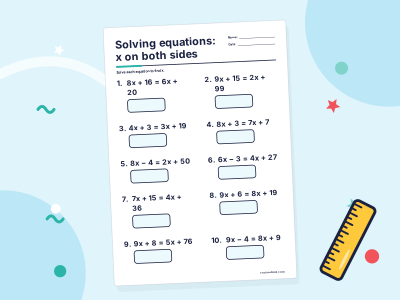
Algebra worksheets to sharpen the basics


Practise it step by step in a full course: Grade 12 Maths
For grown-ups
Related topics
Slope (gradient)
Slope (called gradient in the UK) measures how steep a line is. It is the rise divided by the run, m = (y₂ − y₁) ÷ (x₂ − x₁), and it can be positive, negative, zero or undefined.

Functions (maths)
A function is a rule that gives exactly one output for each input. In f(x) = 2x + 3, the input 4 gives the output 2 × 4 + 3 = 11.
Integration (integrals)
Integration is the reverse of differentiation, and it finds the area under a curve. The power rule says xⁿ integrates to xⁿ⁺¹/(n + 1) + C, so x² becomes x³/3 + C.
Speed, distance and time
Speed is distance divided by time. So speed = distance ÷ time, distance = speed × time, and time = distance ÷ speed. A car that goes 150 km in 2 hours travels at 75 km/h.
Algebra
Algebra is maths that uses letters, like x or n, to stand for numbers we don't know yet or numbers that can change. For example, if n + 3 = 10, then n = 7.

Area of a circle
The area of a circle is pi times the radius squared: A = πr². A circle with radius 5 cm has an area of about 78.5 square centimetres.