Science
What is an atom?
Quick answer
An atom is the tiny building block of all matter. It has a nucleus of protons and neutrons in the middle with electrons around it. The number of protons decides which element it is.
In one sentence
An atom is the smallest piece of an element, and everything around you, from air to your own body, is made of atoms.
Explained
Take a piece of gold and cut it in half, then in half again, and again. Eventually you would reach a piece so small it cannot be cut and still be gold. That's an atom. The word comes from a Greek word meaning "uncuttable".
Atoms are unbelievably small. Hundreds of thousands of them side by side would fit across the width of a human hair.
Every atom has two parts:
- A tiny nucleus in the centre, made of protons (positive charge) and neutrons (no charge).
- Electrons (negative charge), which are much lighter and move around the nucleus in regions called shells.
If an atom were the size of a football stadium, the nucleus would be about the size of a pea on the centre spot. The rest is mostly empty space with electrons zipping around it.
The number of protons is what makes each element different. Hydrogen has 1, carbon has 6, oxygen has 8 and gold has 79. This is called the atomic number, and it's how elements are ordered on the periodic table.
Atoms join together to make molecules. Two hydrogen atoms and one oxygen atom make a molecule of water (H₂O). Oxygen in the air is mostly pairs of oxygen atoms (O₂). By combining in different ways, about a hundred kinds of atom make every substance in the universe.
Moving electrons are also what make electricity.

Examples
| Element | Protons | Found in |
|---|---|---|
| Hydrogen | 1 | water, the Sun |
| Helium | 2 | party balloons |
| Carbon | 6 | pencil "lead" (graphite), diamonds, living things |
| Oxygen | 8 | air, water |
| Iron | 26 | steel, your blood |
| Gold | 79 | jewellery |
Common mistakes
- "Atoms and cells are the same." Cells are living units made of trillions of atoms. Atoms themselves are not alive.
- "Atoms are solid little balls." They are mostly empty space, with a tiny dense nucleus.
- "Electrons orbit like planets." That's a helpful first model, but electrons really exist in fuzzy regions around the nucleus.
Quick quiz
Atoms
Check what you know with 4 quick questions.
Question 1 of 4
Which particle in an atom has a negative charge?
Practise it
Try it
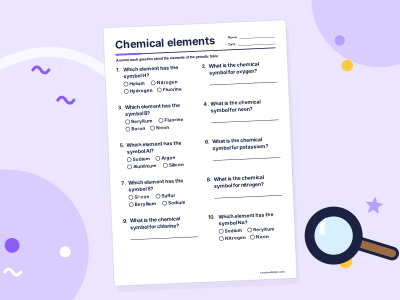
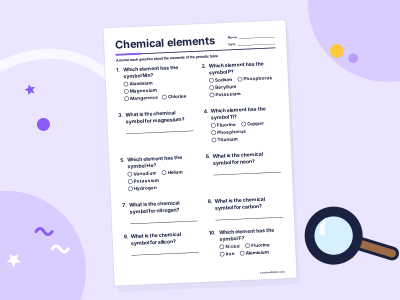
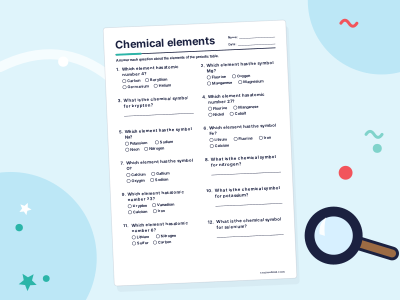
Build model molecules with sweets and cocktail sticks or modelling clay, then try a periodic table activity.
Atoms and elements activities
For grown-ups
Related topics
The periodic table
The periodic table is a chart of all 118 known chemical elements, arranged in order of atomic number. Elements in the same column have similar properties.
Solids, liquids and gases
Solids, liquids and gases are the three main states of matter. Solids keep their shape, liquids flow and take the shape of their container, and gases spread out to fill any space.
Electricity
Electricity is the flow of tiny charged particles called electrons through a material. It powers lights, phones and machines, and it can come from batteries or the mains supply.
Cells
A cell is the smallest living unit. Every living thing is made of one or more cells, each with a membrane, cytoplasm and, in plants and animals, a nucleus that controls it.
Electric circuits
An electric circuit is a complete loop that electricity flows around. A simple circuit has a battery, wires and a component like a bulb. If the loop is broken, the electricity stops.
Evolution
Evolution is the way living things change over many generations. Individuals with features that help them survive tend to have more young, so those features become more common over time.