Science
What is the difference between elements, compounds and mixtures?
Quick answer
An element has only one kind of atom. A compound is two or more elements chemically joined in a fixed ratio, like H₂O. A mixture is substances mixed but not joined, so they can be separated.



In one sentence
An element is made of only one kind of atom, a compound is two or more elements chemically joined together, and a mixture is two or more substances mixed but not joined.
Explained
Everything around you is made of atoms. There are 118 known kinds of atom, and each kind is an element. They are listed on the periodic table. Gold, oxygen, carbon and iron are elements. An element cannot be split into anything simpler by a chemical reaction.
 magnifying glass
 cup
 rock
Some elements exist as single atoms (helium, iron). Others go around in small groups of the same atom: the oxygen you breathe is O₂, two oxygen atoms joined together. That is still an element, because there is only one kind of atom in it.
A compound forms when atoms of different elements bond together in a chemical reaction. Water, H₂O, always has two hydrogen atoms joined to one oxygen atom. Three things are true of every compound:
- It has a fixed ratio of elements, shown by its formula (H₂O, CO₂, NaCl).
- It has new properties, different from the elements it is made of. Sodium is a soft metal that reacts violently with water, and chlorine is a poisonous green gas, yet together they make sodium chloride: table salt.
- It can only be split back into its elements by another chemical reaction, not by filtering or using a magnet.
A mixture is two or more substances that are together but not chemically joined. Sand and water, air, sea water and a bowl of cereal are mixtures. In a mixture:
- the amounts can vary (a little or a lot of sugar in your tea);
- each substance keeps its own properties (sea water still tastes salty);
- the parts can be separated by physical methods such as filtering, evaporating, distillation, using a magnet or chromatography. See separating mixtures.
Mixtures come in two kinds. A homogeneous mixture looks the same all the way through, like salt water or air: these include solutions. A heterogeneous mixture has parts you can see, like sand in water or granite with its coloured specks.
Elements and compounds are both called pure substances, because every particle in them is the same. Chemists mean something different by "pure" than adverts do: "pure orange juice" is a mixture of water, sugars and many other substances.
Scientists often show the difference with particle diagrams. An element shows one kind of circle (single or in identical pairs). A compound shows identical groups made of different circles stuck together. A mixture shows two or more kinds of particle that are not joined to each other.
Examples
| Substance | Type | Why |
|---|---|---|
| Gold (Au) | element | only gold atoms |
| Oxygen gas (O₂) | element | pairs of oxygen atoms, one kind of atom |
| Water (H₂O) | compound | hydrogen and oxygen joined, 2 : 1 |
| Carbon dioxide (CO₂) | compound | carbon and oxygen joined, 1 : 2 |
| Table salt (NaCl) | compound | sodium and chlorine joined, 1 : 1 |
| Air | mixture (homogeneous) | mainly nitrogen and oxygen, not joined |
| Salt water | mixture (homogeneous) | salt dissolved in water |
| Sand and iron filings | mixture (heterogeneous) | a magnet can pull the iron out |
| Brass | mixture (an alloy) | copper and zinc melted together |
In your home: copper in electrical wires and aluminium foil are elements; water, salt, sugar and baking soda are compounds; milk, tea, air, salad dressing and concrete are mixtures. In your body: oxygen, carbon, hydrogen and nitrogen are the main elements, water is the most common compound, and blood is a mixture.
Common mistakes
- "O₂ is a compound because the atoms are joined." A compound needs different elements. O₂, N₂ and H₂ are elements.
- "A compound is just a mixture of elements." In a compound the elements are chemically bonded and the substance has new properties. Water does not behave like hydrogen or oxygen.
- "All mixtures look mixed." Salt water and air look like one substance but are mixtures. Ask: can it be separated without a chemical reaction?
- "Alloys are compounds." Brass and steel are mixtures of metals (steel is iron with a little carbon). Their amounts can vary.
Step by step
Step by step
- Count the kinds of atomIf every particle contains only one kind of atom, it is an element.
- Look for a fixed formulaIf different elements are chemically joined in a fixed ratio (H₂O, CO₂), it is a compound.
- Ask if the parts are separateIf two or more substances are present but not joined, and the amounts can change, it is a mixture.
- Test with a physical methodIf filtering, evaporating or a magnet can separate it, that confirms a mixture.
- Decide what kind of mixtureSame all the way through: homogeneous. Parts you can see: heterogeneous.
Reading a formula: the small number after a symbol tells you how many of that atom there are. No number means one. In H₂SO₄ there are 2 hydrogen, 1 sulfur and 4 oxygen atoms: 7 atoms of 3 elements.
Practice questions
Element, compound or mixture?
Try each one, then check your answer.
- Is helium (He) an element, a compound or a mixture?
Show answer
Only helium atoms: element - Is water (H₂O) an element, a compound or a mixture?
Show answer
Hydrogen and oxygen chemically joined: compound - Is sea water an element, a compound or a mixture?
Show answer
Salt and other substances dissolved in water, not joined: mixture (homogeneous) - Is nitrogen gas (N₂) an element or a compound?
Show answer
Two atoms, but both nitrogen: element - Is carbon dioxide (CO₂) an element, a compound or a mixture?
Show answer
Carbon and oxygen joined: compound - Is granite with visible pink, white and black grains homogeneous or heterogeneous?
Show answer
You can see the different parts: heterogeneous mixture - How many elements and atoms are in CaCO₃ (calcium carbonate)?
Show answer
Ca 1, C 1, O 3: 3 elements, 5 atoms - How many atoms are in one molecule of H₂SO₄ (sulfuric acid)?
Show answer
2 + 1 + 4 = 7 atoms - How many atoms are in one molecule of glucose, C₆H₁₂O₆?
Show answer
6 + 12 + 6 = 24 atoms of 3 elements - How would you separate iron filings from sand?
Show answer
Iron is magnetic and sand is not: use a magnet - Iron and sulfur are heated and glow, making a black solid that a magnet does not attract. What is it?
Show answer
A new substance has formed: the compound iron sulfide (FeS) - A particle diagram shows single circles of two different colours, none touching each other. What does it show?
Show answer
Two elements, not joined: a mixture of two elements - Is brass (copper and zinc) a compound?
Show answer
No. The amounts can vary and the metals are not chemically joined: brass is a mixture (an alloy) - Is distilled water a pure substance?
Show answer
Yes. It contains only H₂O molecules: a pure compound - Why is "pure apple juice" not a pure substance in science?
Show answer
It contains water, sugars, acids and more: it is a mixture
Word problems
Elements, compounds and mixtures in real life
Try each one, then check your answer.
- Salt is made from sea water in shallow ponds in the sun. Which method separates the salt, and what does that tell you about sea water?
Show answer
The water evaporates and the salt stays behind, so sea water is a mixture. - You knock a jar of salt into a tray of sand. How can you get the salt back?
Show answer
Add water to dissolve the salt, filter out the sand, then evaporate the water to leave the salt. - At a recycling centre, a big magnet lifts steel cans out of a pile of drinks cans. Why are aluminium cans left behind?
Show answer
Steel is mostly iron, which is magnetic; aluminium is not magnetic. - 56 g of iron reacts completely with 32 g of sulfur. What mass of iron sulfide forms?
Show answer
Mass is conserved in a reaction: 56 + 32 = 88 g - Baking soda and vinegar fizz when mixed. The bubbles are carbon dioxide. Is CO₂ an element or a compound, and was a new substance made?
Show answer
CO₂ has carbon and oxygen joined, so it is a compound, and yes, it is a new substance, so this is a chemical reaction. - Name an element, a compound and a mixture inside a smartphone.
Show answer
For example: copper in the wiring or silicon in the chips (elements), silicon dioxide in the glass (compound), and the aluminium alloy case (mixture).
Questions people ask
What is the difference between elements, compounds and mixtures?
An element has one kind of atom. A compound has different elements chemically joined in a fixed ratio, with new properties. A mixture has substances that are together but not joined, so the amounts can vary and they can be separated physically.
How do you identify an element, a compound or a mixture?
Look at the formula or the particle diagram. One kind of atom means element; different atoms joined in a fixed formula means compound; separate substances that a physical method can split up means mixture.
What do elements, compounds and mixtures have in common?
They are all forms of matter made of atoms. Elements and compounds are both pure substances, and mixtures are made by putting elements and compounds together.
How are elements, compounds and mixtures related?
Elements are the building blocks. Elements join in chemical reactions to make compounds. Elements and compounds can then be mixed, without joining, to make mixtures.
What are examples of each in daily life?
Element: aluminium foil or copper wire. Compound: water, table salt or sugar. Mixture: air, milk, tea, salad or sea water.
How are they shown in science?
With chemical symbols (O for oxygen), formulas (H₂O) and particle diagrams, where each kind of atom is drawn as a differently coloured circle.
Quick quiz
Elements, compounds and mixtures
Check what you know with 5 quick questions.
Question 1 of 5
Which of these is a compound?
Practise it
Try it
Practise classifying substances with unlimited questions
Atoms and elements worksheets
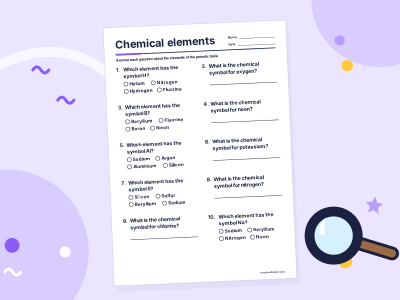
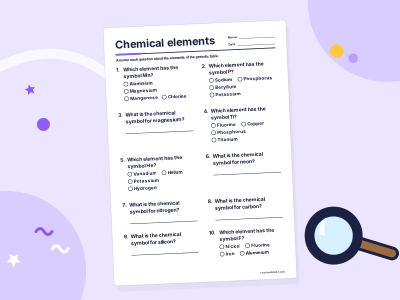
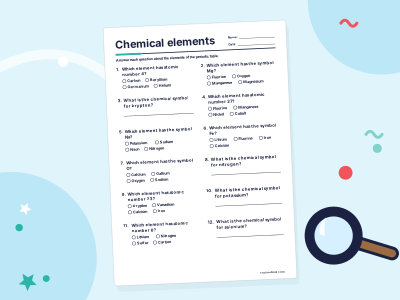
Practise it step by step in a full course: Grade 8 Science
For grown-ups
Related topics
Atoms
An atom is the tiny building block of all matter. It has a nucleus of protons and neutrons in the middle with electrons around it. The number of protons decides which element it is.

The periodic table
The periodic table is a chart of all 118 known chemical elements, arranged in order of atomic number. Elements in the same column have similar properties.
Mixtures and solutions
A mixture is two or more substances mixed but not joined chemically. A solution is a mixture where one substance, like salt, dissolves completely in a liquid, like water.

Chemical reactions
In a chemical reaction, substances change into new substances with different properties. Burning, rusting, baking and cooking are chemical reactions.
The mole (amount of substance)
A mole is the chemist's counting unit: 6.02 × 10²³ particles. To find the number of moles, divide the mass by the molar mass: n = m ÷ M.

Acceleration
Acceleration is how quickly velocity changes. a = (v − u) ÷ t, the change in velocity divided by the time taken, measured in metres per second squared (m/s²).