Science
What is the periodic table?
Quick answer
The periodic table is a chart of all 118 known chemical elements, arranged in order of atomic number. Elements in the same column have similar properties.
In one sentence
The periodic table is a chart that lists every known chemical element in order, grouping together elements that behave in similar ways.
Explained
An element is a substance made of only one kind of atom. Gold, oxygen, carbon and iron are elements. Everything else is made by combining them, just as every word is made from letters of the alphabet.
There are 118 known elements. The periodic table arranges them by atomic number, the number of protons in each atom, starting with hydrogen (1) at the top left.
The layout is clever:
- Rows are called periods. Moving left to right, each element has one more proton than the one before.
- Columns are called groups. Elements in the same group behave in similar ways, like members of a family.
For example, group 1 (apart from hydrogen) holds soft, very reactive metals like sodium and potassium. The far-right column holds the noble gases, such as helium and neon, which hardly react with anything. That is why helium is safe in party balloons.
Most elements are metals (on the left and in the middle). Non-metals, such as oxygen, carbon and nitrogen, are mostly on the right.
In 1869, the Russian chemist Dmitri Mendeleev published a table that arranged elements by their properties. He left gaps where he thought undiscovered elements belonged and predicted what they would be like. When gallium and germanium were found, they matched his predictions closely. That is how scientists became convinced the pattern was real.
Each box usually shows the element's symbol, a one- or two-letter code. Some come from Latin names: Fe for iron (ferrum), Au for gold (aurum), Na for sodium (natrium).

Examples
| Element | Symbol | Atomic number | Fact |
|---|---|---|---|
| Hydrogen | H | 1 | the lightest and most common element in the universe |
| Helium | He | 2 | a noble gas used in balloons |
| Carbon | C | 6 | in all living things |
| Oxygen | O | 8 | we need it to breathe |
| Iron | Fe | 26 | magnetic, used to make steel |
| Gold | Au | 79 | does not rust or tarnish |
Common mistakes
- "Water is an element." Water is a compound of hydrogen and oxygen.
- "Symbols always match the English name." Many come from Latin, like Pb for lead (plumbum).
- "All elements are found in nature." Around 90 occur naturally; the rest have been made in laboratories.
Quick quiz
The periodic table
Check what you know with 4 quick questions.
Question 1 of 4
How many elements are on the periodic table today?
Practise it
Try it
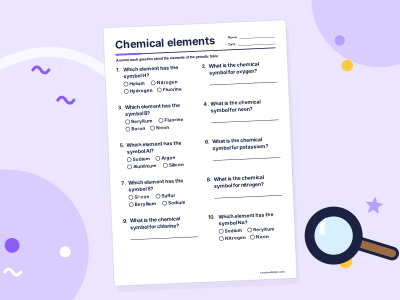
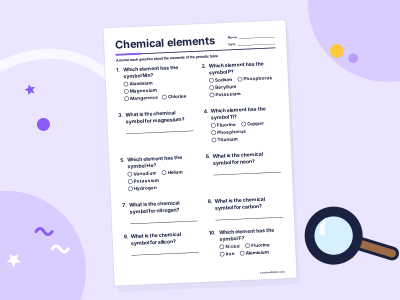
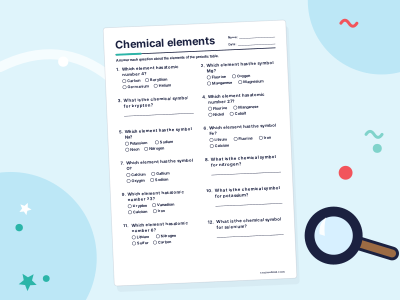
Find the elements in the materials around your home: aluminium foil, copper wire, the carbon in a pencil. Then try periodic table activities.
Periodic table activities
For grown-ups
Related topics
Atoms
An atom is the tiny building block of all matter. It has a nucleus of protons and neutrons in the middle with electrons around it. The number of protons decides which element it is.
Materials
Materials are what objects are made from, such as wood, metal, plastic and glass. Each has properties, like being hard, bendy, waterproof or see-through, that suit it to some jobs.
Solids, liquids and gases
Solids, liquids and gases are the three main states of matter. Solids keep their shape, liquids flow and take the shape of their container, and gases spread out to fill any space.
Cells
A cell is the smallest living unit. Every living thing is made of one or more cells, each with a membrane, cytoplasm and, in plants and animals, a nucleus that controls it.
Evolution
Evolution is the way living things change over many generations. Individuals with features that help them survive tend to have more young, so those features become more common over time.
Electric circuits
An electric circuit is a complete loop that electricity flows around. A simple circuit has a battery, wires and a component like a bulb. If the loop is broken, the electricity stops.