Science
What are solids, liquids and gases?
Quick answer
Solids, liquids and gases are the three main states of matter. Solids keep their shape, liquids flow and take the shape of their container, and gases spread out to fill any space.
In one sentence
Everything is made of matter, and most of it exists as a solid, a liquid or a gas, depending on how its tiny particles are arranged and move.
Explained
All matter is made of tiny particles, far too small to see. How those particles behave decides the state.
Imagine a school hall:
- Solid: everyone is standing in neat rows, holding hands, only wiggling on the spot. The particles are tightly packed in a fixed pattern. A solid keeps its shape and does not flow.
- Liquid: people are still close together but are moving around and sliding past each other. A liquid can flow and pour, and it takes the shape of its container, but its volume stays the same.
- Gas: everyone is running around the whole hall in every direction, far apart. A gas spreads out to fill any space and can be squashed into a smaller space.
Heating or cooling changes the state. Heat gives particles more energy so they move faster.
- Melting: solid → liquid (ice cream on a hot day)
- Freezing: liquid → solid (water in an ice tray)
- Evaporating or boiling: liquid → gas (a puddle drying, a kettle boiling); see evaporation
- Condensing: gas → liquid (drops on a cold window)
Water is special because it is common in all three states on Earth: ice, water and water vapour. That is what powers the water cycle.

Examples
| Solid | Liquid | Gas |
|---|---|---|
| ice | water | water vapour |
| wood | milk | oxygen |
| sand | cooking oil | carbon dioxide |
| butter (cold) | butter (melted) | air (a mixture of gases) |
 ice cream
 juice
juice balloon
Common mistakes
- "Sand and sugar are liquids because they pour." Each grain is a tiny solid that keeps its shape. A pile only pours because the grains are small.
- "The white cloud from a kettle is steam." Real steam is invisible. The cloud is tiny water droplets formed as the steam cools and condenses.
- "Gases weigh nothing." Gases have mass. A balloon full of air is slightly heavier than an empty one.
Quick quiz
Solids, liquids and gases
Check what you know with 4 quick questions.
Question 1 of 4
Which state of matter keeps its own shape?
Practise it
Try it
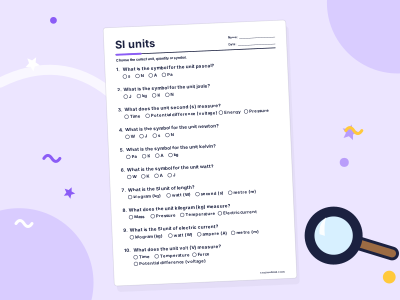
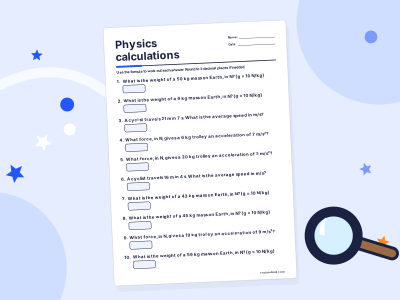
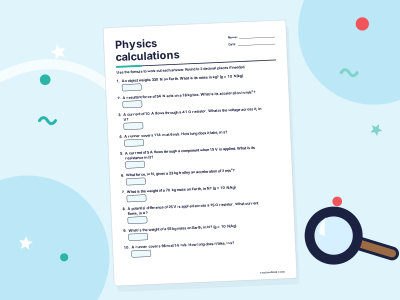
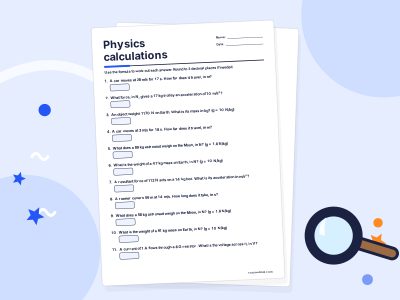
Freeze a few things such as water, juice and yoghurt, then time how long each takes to melt. Then try some physics activities.
States of matter and physics activities
For grown-ups
Related topics
Evaporation
Evaporation is when a liquid slowly turns into a gas from its surface, like a puddle drying in the sun. It happens faster when it is warm, windy or the liquid is spread out.
The water cycle
The water cycle is the endless movement of water between the land, the sea and the sky. Water evaporates, condenses into clouds, falls as rain or snow and collects in rivers and oceans.
Materials
Materials are what objects are made from, such as wood, metal, plastic and glass. Each has properties, like being hard, bendy, waterproof or see-through, that suit it to some jobs.
Atoms
An atom is the tiny building block of all matter. It has a nucleus of protons and neutrons in the middle with electrons around it. The number of protons decides which element it is.
Electric circuits
An electric circuit is a complete loop that electricity flows around. A simple circuit has a battery, wires and a component like a bulb. If the loop is broken, the electricity stops.
Electricity
Electricity is the flow of tiny charged particles called electrons through a material. It powers lights, phones and machines, and it can come from batteries or the mains supply.