Science
What is electricity?
Quick answer
Electricity is the flow of tiny charged particles called electrons through a material. It powers lights, phones and machines, and it can come from batteries or the mains supply.
In one sentence
Electricity is energy carried by tiny charged particles moving through a material, and we use it to power lights, heaters, phones and much more.
Explained
Everything is made of atoms, and atoms contain even tinier particles called electrons, which carry a negative charge. When electrons flow along a wire, that flow is an electric current.
Think of a wire as a pipe already full of marbles. Push one marble in at one end, and one pops out the other end almost instantly. The battery or power station is the push. This is why a light switches on as soon as you flick the switch.
Electricity needs a complete loop to flow, called a circuit. Break the loop, and the flow stops.
Some materials let electricity flow easily. These are conductors: most metals, such as copper, aluminium and iron. Others block it. These are insulators: plastic, rubber, wood, glass and dry fabric. Wires are made of copper with a plastic coating so the electricity goes where it's meant to and not into us.
We get electricity from two main places:
- Batteries store energy as chemicals and release it as a small, safe current. A typical AA battery is 1.5 volts.
- Mains electricity comes from power stations, wind turbines and solar panels, along cables to sockets in our homes. It is much stronger, about 230 volts in the UK, Nigeria and much of the world, and about 120 volts in the US and Canada.
Static electricity is charge that builds up in one place instead of flowing, like when you rub a balloon on your hair and it sticks to the wall. Lightning is a gigantic spark of static electricity.

Examples
| Uses batteries | Uses mains electricity |
|---|---|
| torch | fridge |
| TV remote | washing machine |
| toy car | kettle |
| watch | ceiling lights |
Common mistakes
- "Batteries are full of electricity." They store chemical energy that becomes electrical energy when a circuit is connected.
- "Electricity gets used up in a bulb." The electrons are not used up; they carry energy round the circuit and the bulb turns some into light and heat.
- "Wood and water always insulate." Dry wood does, but tap water conducts electricity, which is why water and electricity are a dangerous mix.
Quick quiz
Electricity
Check what you know with 4 quick questions.
Question 1 of 4
What is electric current?
Practise it
Try it
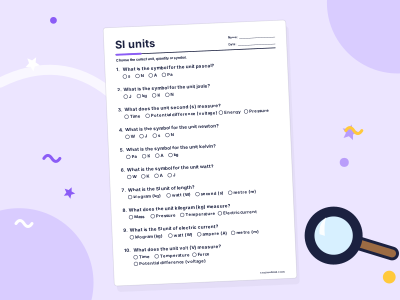
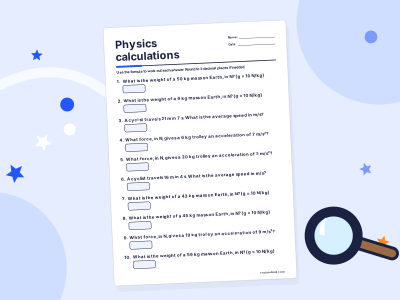
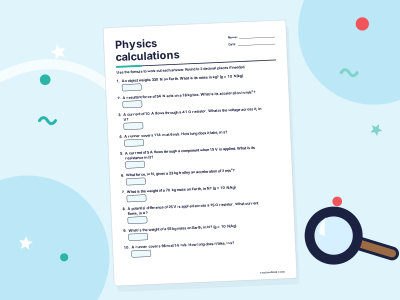
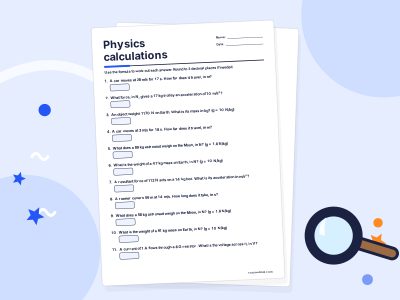
Rub a balloon on a wool jumper and see what it can pick up. Then try some physics activities.
Electricity and physics activities
For grown-ups
Related topics
Electric circuits
An electric circuit is a complete loop that electricity flows around. A simple circuit has a battery, wires and a component like a bulb. If the loop is broken, the electricity stops.
Atoms
An atom is the tiny building block of all matter. It has a nucleus of protons and neutrons in the middle with electrons around it. The number of protons decides which element it is.
Magnets
A magnet is an object that pulls on certain metals, such as iron, and pushes or pulls on other magnets. Every magnet has a north pole and a south pole.
Materials
Materials are what objects are made from, such as wood, metal, plastic and glass. Each has properties, like being hard, bendy, waterproof or see-through, that suit it to some jobs.
Forces
A force is a push or a pull. Forces can make things start moving, speed up, slow down, change direction or change shape. They are measured in newtons.
Friction
Friction is a force that acts when two surfaces rub or slide against each other. It slows things down and turns movement into heat, and it also stops us slipping.