Crayonbird
Menu

Science · Ages 8–9 · 55 minutes

Sound and vibrations

Children explain that sounds are made by vibrations, that sound travels through materials to our ears, and that pitch and volume can be changed.

Success criteria

  • I can explain that sounds are made by vibrations
  • I can describe how sound travels to my ears
  • I can change the pitch and volume of a sound

Key vocabulary

  • vibrate
  • vibration
  • sound
  • pitch
  • high
  • low
  • volume
  • loud
  • quiet
  • travel

You will need

  • plastic bowls covered tightly with cling film
  • a few grains of dry rice
  • elastic bands of different thicknesses
  • small boxes or tubs
  • plastic cups and string (about 5 m)
  • rulers
  • a drum or tambourine
  • Year 4· England

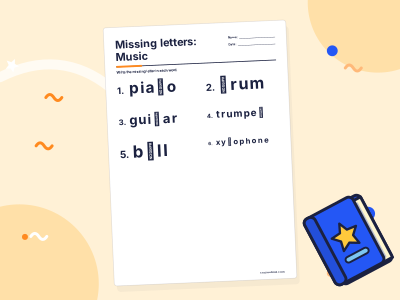
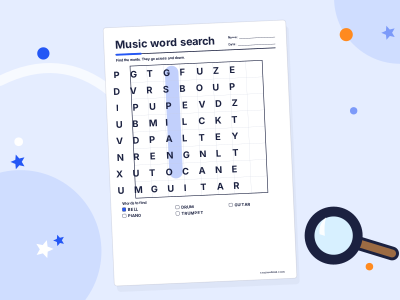
Practice sheets

Generated fresh each time you press a button, and marked instantly on screen.

The lesson at a glance

55 minutes in all. Timings are a guide: follow your class.

  1. Step 1: Starter

    Ask everyone to rest two fingers gently on the front of their throat and hum, then stop, then hum again.
    6 minutes
  2. Step 2: Teach

    Explain: "Every sound is made by something vibrating: shaking backwards and forwards very fast.
    10–15 min
  3. Step 3: Guided practice

    Run three stations, rotating every five minutes.
  4. Step 4: Independent practice

    Use the practice buttons.
  5. Step 5: Plenary

    Hold up the ruler over the edge of a table (hold one end down firmly) and twang it.
  6. Step 6: Assessment for learning

    Do children connect every sound to something vibrating?
  7. Step 7: Differentiation

    Support: use only the jumping rice and the elastic band stations, with picture prompts for high and low.
  8. Step 8: Common misconceptions

    "Loud and high mean the same." Pitch is high or low; volume is loud or quiet.
  9. Step 9: Home link

    Make a shaker from a closed container and dry rice or pasta, then find ways to make it louder and quieter.

Children hear sound all day without thinking about what it is. This lesson makes vibrations visible with jumping rice, stretchy elastic bands and a string telephone, so they can see what usually only reaches their ears.

1.Starter

6 minutes

Ask everyone to rest two fingers gently on the front of their throat and hum, then stop, then hum again. "What can you feel?" Then whisper the same word. "What changed?" Take answers about buzzing or shaking. Six minutes.

2.Teach

10–15 min

Explain: "Every sound is made by something vibrating: shaking backwards and forwards very fast. When you hum, parts of your throat vibrate."

Tap a drum and place a few grains of rice on top. "Watch the rice. The drum skin is vibrating, even though it is too fast to see." Then explain how sound reaches us: "The vibrations pass through the air, from one tiny bit of air to the next, until they reach your ear. Sound can travel through solids and liquids too."

Introduce two ideas with the elastic band and box:

  • "Volume is how loud or quiet a sound is. A bigger pluck makes bigger vibrations and a louder sound."
  • "Pitch is how high or low a sound is. A tighter or thinner band vibrates faster and makes a higher sound."
  • drum
  • guitar
  • piano
  • trumpet
  • xylophone
  • ear
Different instruments, same idea: something vibrates.

The rest of the plan

Guided and independent practice, the plenary, assessment for learning, differentiation, common misconceptions and the home link are free with a Crayonbird account.

  1. Guided practice
  2. Independent practice
  3. Plenary
  4. Assessment for learning
  5. Differentiation
  6. Common misconceptions
  7. Home link

Learning Wiki

Evaporation

Evaporation is when a liquid slowly turns into a gas from its surface, like a puddle drying in the sun. It happens faster when it is warm, windy or the liquid is spread out.

Food chains

A food chain shows who eats whom in nature, starting with a plant that makes its own food and following the energy as it passes from one living thing to the next.

Skeleton

The skeleton is the frame of bones inside your body. It holds you up, protects soft organs like the brain and heart, and works with muscles so you can move. Adults have 206 bones.

  • Science · Ages 8–9 · 60 min

    Building simple circuits

    Children build a simple series circuit with a cell, wires and a bulb, explain why a circuit must be complete, and use a switch to open and close it.

  • Science · Ages 7–9 · 55 min

    Animal life cycles

    Children sequence the life cycles of a butterfly, a frog and a bird, and explain how a young animal changes as it grows into an adult.

  • Science · Ages 7–9 · 55 min

    Light sources and shadows

    Children recognise that we need light to see, sort light sources from reflectors, and explain that a shadow forms when an opaque object blocks light and changes size as the object moves.