Crayonbird
Menu

Study skills · Ages 11–16 · 60 minutes

Revision that works: active recall and spacing

Students explain why testing yourself works better than rereading, and build a short revision routine that uses active recall, feedback and spaced practice.

Success criteria

  • I can explain the difference between rereading and active recall
  • I can turn my notes into questions and test myself
  • I can plan when to revisit a topic

Key vocabulary

  • active recall
  • retrieval practice
  • spaced practice
  • cramming
  • feedback
  • self-test
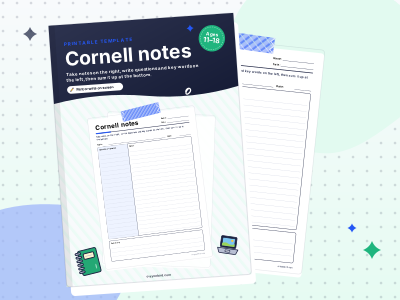
  • Cornell notes
  • revision timetable

You will need

  • a short text or set of notes from a current topic
  • blank paper
  • coloured pens
  • timers
  • mini whiteboards

Practice sheets

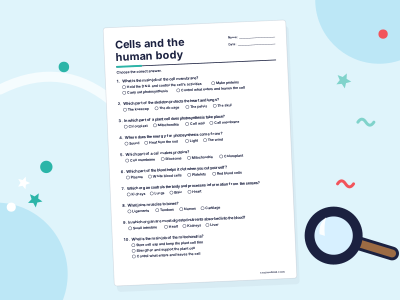
Generated fresh each time you press a button, and marked instantly on screen.

The lesson at a glance

60 minutes in all. Timings are a guide: follow your class.

  1. Step 1: Starter

    Ask: "How do you usually revise?
    7 minutes
  2. Step 2: Teach

    Explain the two big ideas with script lines.
    10–15 min
  3. Step 3: Guided practice

    Run a short experiment.
  4. Step 4: Independent practice

    Use the practice buttons.
  5. Step 5: Plenary

    Ask: "Which feels easier: rereading or active recall?
  6. Step 6: Assessment for learning

    Can students explain why rereading feels effective but often is not?
  7. Step 7: Differentiation

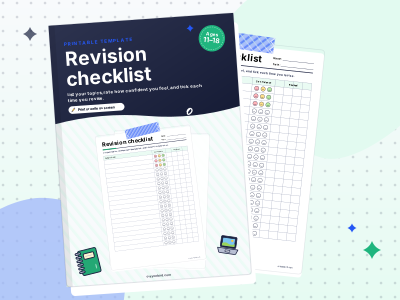
    Support: provide the questions for the Cornell column and a partly filled revision checklist.
  8. Step 8: Common misconceptions

    "If it feels familiar, I know it." Familiarity is not the same as being able to recall it.
  9. Step 9: Home link

    At home, students explain one topic out loud to a family member without notes, then check the notes together to see what was missed.

Most students revise by rereading notes and highlighting, because it feels productive. Research on learning has found for a long time that testing yourself and spreading revision out work better. This lesson lets students experience the difference for themselves, so the technique sells itself.

1.Starter

7 minutes

Ask: "How do you usually revise? Write down the one thing you do most." Collect answers anonymously on sticky notes and sort them on the board: rereading, highlighting, rewriting notes, making flashcards, testing yourself, watching videos. Most classes cluster on rereading and highlighting. Seven minutes.

2.Teach

10–15 min

Explain the two big ideas with script lines.

Active recall (retrieval practice): "When you reread, the information is in front of you, so it feels familiar. That is not the same as being able to remember it in an exam. Active recall means closing the book and pulling the information out of your memory. That effort is what makes it stick."

Spaced practice: "Cramming everything the night before can get you through tomorrow, but you forget it quickly. If you come back to a topic after a day, then a few days, then a week, you remember it for much longer."

Then add the part students usually miss: "Getting answers wrong when you test yourself is fine, as long as you check and correct them. Mistakes plus feedback is how you learn."

Model a quick active recall routine on the board:

Step by step

  1. Read onceRead a section of notes carefully.
  2. Close and recallCover the notes and write or say everything you can remember.
  3. CheckOpen the notes and mark what you missed in a different colour.
  4. Repeat laterWrite a date for when you will test yourself on it again.

The rest of the plan

Guided and independent practice, the plenary, assessment for learning, differentiation, common misconceptions and the home link are free with a Crayonbird account.

  1. Guided practice
  2. Independent practice
  3. Plenary
  4. Assessment for learning
  5. Differentiation
  6. Common misconceptions
  7. Home link

Learning Wiki

Revision timetable

A revision timetable is a plan of what to revise and when. Good ones use short sessions, mix subjects, revisit topics after gaps and leave time for rest.

Exam technique

Exam technique is the set of skills for answering the paper well on the day, such as reading questions carefully, using marks to plan time and checking your work.

Note-taking

Good notes are short, in your own words and organised so you can test yourself later. Methods like Cornell notes build in questions and a summary.

  • Study skills · Ages 7–10 · 50 min

    Staying safe online

    Children know which information should stay private online, know that they should stop and tell a trusted adult whenever something online worries them, and practise what to say.

  • Study skills · Ages 7–9 · 50 min

    Algorithms without a computer

    Children write a clear, ordered set of instructions (an algorithm) to complete a task, test it, and debug it when it goes wrong.

  • Maths · Ages 11–12 · 55 min

    Mean, median, mode and range

    Pupils calculate the mean, median, mode and range of a small data set and explain what each one tells you about the data.