Science
What is momentum in physics, and what is the formula?
Quick answer
Momentum is mass in motion: momentum = mass × velocity, p = mv, measured in kg m/s. It has a direction, and in a collision the total momentum stays the same.



In one sentence
Momentum is how much "oomph" a moving object has: its mass multiplied by its velocity, p = mv.
Explained
Imagine trying to stop two things rolling towards you at the same speed: a football and a car. The car is far harder to stop because it has much more mass. Now imagine two footballs, one rolling gently and one kicked hard. The fast one is harder to stop. Momentum combines both ideas into one number:
momentum = mass × velocity, p = m × v
Mass is in kilograms and velocity in metres per second, so momentum is measured in kg m/s (you may also see N s, which is the same unit). The symbol is p. A 1,200 kg car moving at 15 m/s has a momentum of 1,200 × 15 = 18,000 kg m/s.
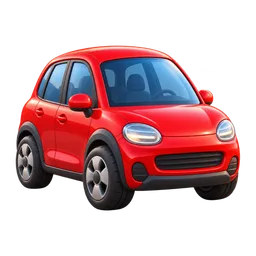 car
 ball
 rocket
Momentum is a vector: it has a direction, the same as the velocity. In a calculation you choose one direction as positive, for example to the right, and then anything moving the other way has a negative momentum. Something that is not moving has zero momentum. The idea of a vector is explained in vectors, and velocity is speed in a direction (see speed, distance and time).
The most useful fact about momentum is the law of conservation of momentum: in a closed system (no outside forces such as friction), the total momentum before a collision or explosion equals the total momentum after it. Momentum can pass from one object to another, but none is created or lost.
- Collisions: a moving trolley hits a still one and they stick together. They now share the momentum, so together they move more slowly.
- Explosions and recoil: before a gun is fired, the total momentum is zero. Afterwards the bullet goes forwards and the gun kicks backwards, so the two momenta still add up to zero. Rockets work the same way: hot gas is pushed backwards, so the rocket is pushed forwards.
Momentum is also linked to forces. A force changes an object's momentum, and the bigger the force or the longer it acts, the bigger the change. The impulse is force × time, and it equals the change in momentum:
F × t = change in momentum, so F = change in momentum ÷ time
This is why safety features work. In a crash your momentum must drop to zero whatever happens. Airbags, seat belts, crumple zones and bike helmets make the stop take longer, so the force on your body is smaller. A goalkeeper pulling the hands back when catching a ball does the same thing.
Momentum is not the same as kinetic energy. In every collision in a closed system momentum is conserved, but kinetic energy usually is not: some becomes heat and sound. A collision that keeps all the kinetic energy is called elastic; one that loses some is inelastic.
Examples
| Object | Mass | Velocity | Momentum |
|---|---|---|---|
| Tennis ball served | 0.058 kg | 50 m/s | 2.9 kg m/s |
| Person running | 70 kg | 8 m/s | 560 kg m/s |
| Car on a town road | 1,200 kg | 15 m/s | 18,000 kg m/s |
| Lorry on a motorway | 40,000 kg | 25 m/s | 1,000,000 kg m/s |
| Ball rolling left (right is positive) | 0.5 kg | −6 m/s | −3 kg m/s |
Worked example: a 4 kg trolley moving at 6 m/s hits a still 2 kg trolley and they stick together. Momentum before = 4 × 6 + 2 × 0 = 24 kg m/s. After, the total mass is 6 kg, so 6 × v = 24 and v = 4 m/s.
Common mistakes
- Forgetting the direction. If one object moves left, its momentum is negative. 3 kg at 4 m/s right and 2 kg at 5 m/s left have a total of 12 − 10 = 2 kg m/s, not 22.
- Using the wrong mass after a collision. If the objects stick together, use their combined mass for the velocity afterwards.
- Mixing up momentum and kinetic energy. Momentum is mv (a vector); kinetic energy is ½mv² (a scalar, in joules). Only momentum is always conserved in a collision.
- Using grams. Convert to kilograms first: 58 g = 0.058 kg.
Step by step
Step by step
- Choose a positive directionFor example, right is positive and left is negative. Write down every mass and velocity with its sign.
- Work out the momentum beforeFind m × v for each object and add them up (with signs).
- Write "momentum before = momentum after"This is true for any collision or explosion in a closed system.
- Solve for the unknownUsually a velocity after the collision. If objects stick, use their total mass.
- Check the directionA negative answer means the object moves the opposite way to your positive direction.
For forces, use F = change in momentum ÷ time, where the change in momentum is (final momentum − starting momentum).
Practice questions
Momentum calculations
Try each one, then check your answer.
- Find the momentum of a 2 kg ball moving at 3 m/s.
Show answer
p = 2 × 3 = 6 kg m/s - Find the momentum of a 1,200 kg car moving at 15 m/s.
Show answer
p = 1,200 × 15 = 18,000 kg m/s - A 70 kg runner moves at 8 m/s. What is her momentum?
Show answer
p = 70 × 8 = 560 kg m/s - A 2,500 kg truck has a momentum of 50,000 kg m/s. How fast is it moving?
Show answer
v = p ÷ m = 50,000 ÷ 2,500 = 20 m/s - An object moving at 4 m/s has a momentum of 24 kg m/s. What is its mass?
Show answer
m = p ÷ v = 24 ÷ 4 = 6 kg - A 0.5 kg ball rolls to the left at 6 m/s. Taking right as positive, what is its momentum?
Show answer
p = 0.5 × (−6) = −3 kg m/s - A 3 kg trolley moves right at 4 m/s and a 2 kg trolley moves left at 5 m/s. What is the total momentum?
Show answer
12 + (−10) = 2 kg m/s to the right - A 4 kg trolley at 6 m/s hits a still 2 kg trolley and they stick. Find their velocity.
Show answer
24 = 6 × v, so v = 4 m/s - In question 8, was kinetic energy conserved?
Show answer
Before: ½ × 4 × 6² = 72 J. After: ½ × 6 × 4² = 48 J. No: 24 J was lost, so the collision is inelastic. - A 1,000 kg car at 20 m/s crashes into a still 1,500 kg car and they move off together. Find their velocity.
Show answer
20,000 = 2,500 × v, so v = 8 m/s - A 2 kg ball moving right at 3 m/s hits a 1 kg ball moving left at 4 m/s and they stick. Find the velocity.
Show answer
Total = 6 − 4 = 2 kg m/s; v = 2 ÷ 3 ≈ 0.67 m/s to the right - A 4 kg rifle fires a 0.02 kg bullet at 400 m/s. Find the recoil velocity of the rifle.
Show answer
Bullet: 0.02 × 400 = 8 kg m/s. Rifle: 8 ÷ 4 = 2 m/s backwards - A force of 50 N acts for 0.2 s. What is the change in momentum?
Show answer
50 × 0.2 = 10 kg m/s (10 N s) - A 0.4 kg football goes from rest to 25 m/s. The kick lasts 0.05 s. Find the average force.
Show answer
Change = 0.4 × 25 = 10 kg m/s; F = 10 ÷ 0.05 = 200 N - A 0.2 kg ball hits a wall at 10 m/s and bounces straight back at 8 m/s. Find the size of its change in momentum.
Show answer
0.2 × (−8) − 0.2 × 10 = −1.6 − 2 = −3.6, so 3.6 kg m/s
Word problems
Momentum in real life
Try each one, then check your answer.
- A 70 kg driver stops from 15 m/s in a crash. Find the average force if the stop takes 0.05 s, and if an airbag makes it take 0.25 s.
Show answer
Change = 70 × 15 = 1,050 kg m/s. 21,000 N without, 4,200 N with the airbag: 5 times smaller. - Two ice skaters, 60 kg and 40 kg, stand still and push apart. The 60 kg skater moves off at 2 m/s. How fast does the other move?
Show answer
Total stays 0: 60 × 2 = 120, so 120 ÷ 40 = 3 m/s in the opposite direction - A tennis ball of mass 0.058 kg is served from rest to 50 m/s. The racket touches it for 0.005 s. Find the average force.
Show answer
Change = 0.058 × 50 = 2.9 kg m/s; F = 2.9 ÷ 0.005 = 580 N - A 30,000 kg railway wagon at 2 m/s joins onto a still 20,000 kg wagon. How fast do they move together?
Show answer
60,000 ÷ 50,000 = 1.2 m/s - Why does a cricket or baseball player pull their hands back when catching a fast ball?
Show answer
The ball's change in momentum is the same either way, but a longer stopping time means a smaller force on the hands, so it hurts less.
Questions people ask
What is the formula for momentum?
p = m × v: momentum equals mass in kilograms times velocity in metres per second. Rearranged, v = p ÷ m and m = p ÷ v.
What is momentum measured in?
In kilograms metres per second, kg m/s. The newton second, N s, is exactly the same unit, because 1 N = 1 kg m/s².
What is momentum in simple words?
It is how hard it is to stop something that is moving. Heavy objects and fast objects have lots of momentum; a parked car has none.
What is the law of conservation of momentum?
In a closed system, the total momentum before an event (a collision or an explosion) equals the total momentum after it. Momentum is shared out differently, but the total stays the same.
Can momentum be negative?
Yes. Momentum has a direction, so if you call one direction positive, anything moving the opposite way has negative momentum. The size of the momentum is never negative.
What is the difference between momentum and impulse?
Momentum is what a moving object has (mv). Impulse is what a force gives it: force × time. The impulse on an object equals its change in momentum.
Does light have momentum?
Yes, even though light has no mass. A photon's momentum is p = h ÷ λ, where h is the Planck constant (about 6.63 × 10⁻³⁴ J s) and λ is the wavelength. This is a more advanced idea met later in physics.
Quick quiz
Momentum
Check what you know with 5 quick questions.
Question 1 of 5
What is the unit of momentum?
Practise it
Try it
Practise momentum with unlimited questions
Physics worksheets


Practise it step by step in a full course: Grade 11 Science
For grown-ups
Related topics
Forces
A force is a push or a pull. Forces can make things start moving, speed up, slow down, change direction or change shape. They are measured in newtons.

Speed, distance and time
Speed is distance divided by time. So speed = distance ÷ time, distance = speed × time, and time = distance ÷ speed. A car that goes 150 km in 2 hours travels at 75 km/h.

Mass and weight
Mass is how much stuff is in an object, measured in grams and kilograms. Weight is the pull of gravity on that mass. In everyday life people say weight for both.

Energy
Energy is what makes things happen: it makes things move, heat up, light up and grow. It cannot be created or destroyed, only changed from one form to another.
Acceleration
Acceleration is how quickly velocity changes. a = (v − u) ÷ t, the change in velocity divided by the time taken, measured in metres per second squared (m/s²).
Kinetic energy
Kinetic energy is the energy an object has because it is moving. The formula is KE = ½mv², with mass in kg and speed in m/s, and the answer is in joules (J).