Crayonbird
Menu

Science · Ages 8–10 · 55 minutes

The water cycle

Children describe the water cycle using evaporation, condensation, precipitation and collection, and explain how the Sun's heat drives it.

Success criteria

  • I can name the four stages of the water cycle
  • I can explain evaporation and condensation
  • I can draw a labelled water cycle with arrows

Key vocabulary

  • evaporation
  • condensation
  • precipitation
  • collection
  • water vapour
  • cloud
  • droplet
  • cycle

You will need

  • zip-lock bags
  • water
  • blue food colouring
  • marker pens
  • tape
  • a small mirror or cold metal spoon
  • a damp cloth
  • A3 paper
  • Year 4· England

Practice sheets

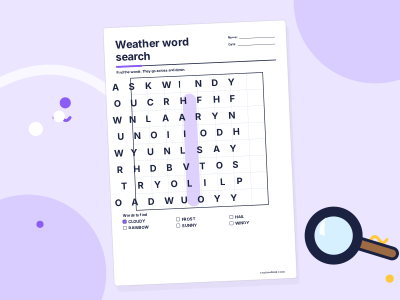
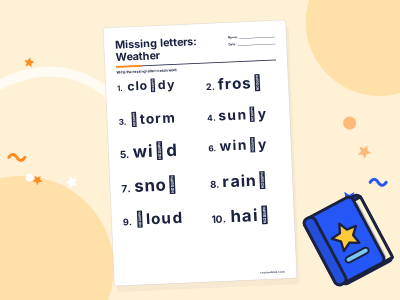
Generated fresh each time you press a button, and marked instantly on screen.

The lesson at a glance

55 minutes in all. Timings are a guide: follow your class.

  1. Step 1: Starter

    Wipe a damp cloth across the board or a dark table.
    5–10 min
  2. Step 2: Teach

    Draw a hill, the sea, a cloud and the Sun on the board, and build the cycle with arrows as you talk.
    10–15 min
  3. Step 3: Guided practice

    Make a water cycle in a bag.
  4. Step 4: Independent practice

    Children draw a labelled water cycle on A3 with all four stage words and arrows.
  5. Step 5: Plenary

    Go back to the wet patch from the starter.
  6. Step 6: Assessment for learning

    Do children use the four stage names in the right order?
  7. Step 7: Differentiation

    Support: give a cycle diagram with the arrows printed and a word bank to stick on.
  8. Step 8: Common misconceptions

    "Clouds are made of steam or smoke." They are tiny drops of water or ice.
  9. Step 9: Home link

    After a bath or shower, look at the mirror together and talk about where the misty droplets came from.

The water that falls as rain today has been rain many times before. This lesson makes that idea visible with a water cycle in a bag, taped to a sunny window, and gives children the four big words they will need to explain it.

1.Starter

5–10 min

Wipe a damp cloth across the board or a dark table. Ask: "Where will this water go?" Take guesses and leave the patch to dry while you teach. Then breathe on a cold mirror or a metal spoon and ask: "Where did this water come from?" Eight minutes.

2.Teach

10–15 min

Draw a hill, the sea, a cloud and the Sun on the board, and build the cycle with arrows as you talk.

  • Evaporation: "The Sun warms the water in seas, lakes and puddles. Some of it turns into an invisible gas called water vapour and rises into the air. That is what happened to our wet patch."
  • Condensation: "High up, the air is colder. The water vapour cools and turns back into tiny droplets. Billions of droplets together make a cloud. That is what happened on the mirror."
  • Precipitation: "When the droplets join up and get too heavy, they fall as rain, snow or hail."
  • Collection: "The water collects in rivers, lakes, the ground and the sea, and the cycle starts again."

Say: "Nothing new is added and nothing is used up. The same water goes round and round."

  • sun
  • cloud
  • rain
  • snow
  • wave
  • mountain
The Sun, clouds, rain and snow, the sea and the hills: the whole cycle in six pictures.

The rest of the plan

Guided and independent practice, the plenary, assessment for learning, differentiation, common misconceptions and the home link are free with a Crayonbird account.

  1. Guided practice
  2. Independent practice
  3. Plenary
  4. Assessment for learning
  5. Differentiation
  6. Common misconceptions
  7. Home link

Learning Wiki

Evaporation

Evaporation is when a liquid slowly turns into a gas from its surface, like a puddle drying in the sun. It happens faster when it is warm, windy or the liquid is spread out.

The water cycle

The water cycle is the endless movement of water between the land, the sea and the sky. Water evaporates, condenses into clouds, falls as rain or snow and collects in rivers and oceans.

Seasons

Seasons happen because Earth is tilted. As Earth orbits the Sun over a year, each half of the planet takes turns leaning towards the Sun, getting more direct sunlight and longer days.

  • Science · Ages 8–10 · 55 min

    Solids, liquids and gases

    Children sort materials into solids, liquids and gases using their properties, and observe ice melting as an example of a change of state.

  • Science · Ages 8–10 · 55 min

    Building and reading food chains

    Children build food chains that start with a plant, use arrows to show the direction the energy goes, and identify producers, prey and predators.

  • Science · Ages 8–9 · 60 min

    Building simple circuits

    Children build a simple series circuit with a cell, wires and a bulb, explain why a circuit must be complete, and use a switch to open and close it.