Crayonbird
Menu

English · Ages 8–10 · 55 minutes

Summarising a text

Children identify the main ideas across several paragraphs of a text and summarise them in their own words within a word limit, leaving out minor details.

Success criteria

  • I can find the main idea of each paragraph
  • I can leave out details that are not important
  • I can write a summary in my own words within a word limit

Key vocabulary

  • summary
  • summarise
  • main idea
  • key point
  • detail
  • own words
  • word limit

You will need

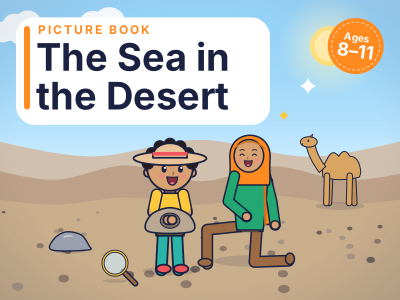
  • the story The Sea in the Desert
  • highlighters in two colours
  • sticky notes
  • mini whiteboards
  • Year 4· England
  • Grade 3· United States

Practice sheets

Generated fresh each time you press a button, and marked instantly on screen.

The lesson at a glance

55 minutes in all. Timings are a guide: follow your class.

  1. Step 1: Starter

    Film in a sentence: "Tell me about a film or book everyone knows, in one sentence." Let a few children try.
    7 minutes
  2. Step 2: Teach

    Read The Sea in the Desert aloud while children follow.
    15 minutes
  3. Step 3: Guided practice

    Important or not? Read out details from the story.
    10 minutes
  4. Step 4: Independent practice

    Use the practice buttons.
    18 minutes
  5. Step 5: Plenary

    Summary showdown: two children read their summaries of the same story.
    5 minutes
  6. Step 6: Assessment for learning

    Does the summary include the main problem and outcome, or only the opening?
  7. Step 7: Differentiation

    Support: give the paragraph headlines with one missing for the child to write, then a frame: This story is about .
  8. Step 8: Common misconceptions

    Retelling everything: the summary is nearly as long as the story.
  9. Step 9: Home link

    After your child watches a programme or reads a chapter, ask them to tell you what it was about in exactly three sentences.

1.Starter

7 minutes

Film in a sentence: "Tell me about a film or book everyone knows, in one sentence." Let a few children try. Most will start with lots of detail and run out of breath.

"Now in ten words." Count on your fingers as they speak.

"What did you have to leave out? How did you decide?" We kept the main bit. We left out the little things.

"That's summarising: keeping the most important ideas and saying them briefly, in your own words."

2.Teach

15 minutes

Read The Sea in the Desert aloud while children follow.

Model summarising paragraph by paragraph. Ask "What is this paragraph mostly about?" and write a short headline for each:

  1. Salma is surprised that they will look for sea creatures in the desert.
  2. Her aunt, a geologist, takes her to the stony hills in Morocco.
  3. The land was once under the sea, and dead sea animals turned into fossils.
  4. Salma searches for a long time and finds a stone with lines on it.
  5. It's a trilobite, older than the dinosaurs.
  6. Salma decides she wants to be a geologist.

"Now I join my headlines and cut anything repeated."

Model a summary of about 40 words:

Salma's aunt, a geologist, takes her fossil hunting in the Moroccan desert, which was once under the sea. After a long search, Salma finds a trilobite older than the dinosaurs, and decides she wants to study rocks too.

Show the tools you used:

  • Cut the small details: the colour of the stones, her sore knees.
  • Combine ideas into one sentence.
  • Use your own words, not copied sentences.
  • Replace lists with one umbrella word.

The rest of the plan

Guided and independent practice, the plenary, assessment for learning, differentiation, common misconceptions and the home link are free with a Crayonbird account.

  1. Guided practice10 minutes
  2. Independent practice18 minutes
  3. Plenary5 minutes
  4. Assessment for learning
  5. Differentiation
  6. Common misconceptions
  7. Home link

Learning Wiki

Fact and opinion

A fact is something that can be checked and proved true or false. An opinion is what someone thinks or feels, and other people may disagree.

Inference

Inference means working out something the writer has not said directly, using clues in the text plus what you already know. It is often called reading between the lines.

Summarising

Summarising means retelling the most important ideas of a text briefly, in your own words, leaving out small details and examples.

  • English · Ages 8–9 · 55 min

    Fronted adverbials

    Children identify adverbials that tell when, where or how something happens, move them to the front of a sentence, and use a comma after a fronted adverbial.

  • English · Ages 8–9 · 55 min

    Organising writing into paragraphs

    Children explain why writers start a new paragraph, spot paragraph changes caused by time, place, topic or a new speaker, and organise their own writing into paragraphs.

  • English · Ages 8–9 · 60 min

    Writing a persuasive letter

    Children write a letter that persuades a real reader to agree to a request, giving clear reasons with evidence, using persuasive language and a polite letter layout.