Crayonbird
Menu

English · Ages 8–9 · 60 minutes

Writing a persuasive letter

Children write a letter that persuades a real reader to agree to a request, giving clear reasons with evidence, using persuasive language and a polite letter layout.

Success criteria

  • I can state clearly what I want
  • I can give at least three reasons with evidence
  • I can use persuasive language and set out my letter correctly

Key vocabulary

  • persuade
  • opinion
  • reason
  • evidence
  • audience
  • formal
  • rhetorical question

You will need

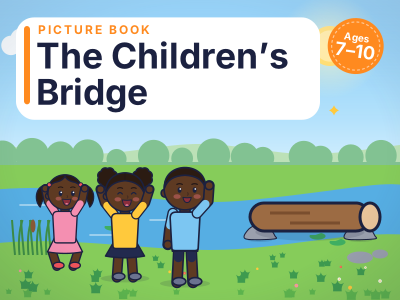
  • the story The Children's Bridge
  • a short model letter
  • sticky notes in two colours
  • highlighters
  • Year 4· England
  • Grade 3· United States

Practice sheets

Generated fresh each time you press a button, and marked instantly on screen.

  • Sheet 1

    The Children’s Bridge

  • Sheet 2

    Main idea and details

    PrintPaper only
  • Sheet 3

    Main idea and details

    PrintPaper only
  • Sheet 4

    Write a friendly letter

    PrintPaper only

The lesson at a glance

60 minutes in all. Timings are a guide: follow your class.

  1. Step 1: Starter

    Convince me: "I'm thinking of cancelling playtime tomorrow so we can do extra spelling.
    8 minutes
  2. Step 2: Teach

    Read The Children's Bridge together, or recap it if the class read it earlier.
    15 minutes
  3. Step 3: Guided practice

    Choose an issue as a class: a longer lunch break, a reading corner, a bench by the gate, a recycling scheme.
    10 minutes
  4. Step 4: Independent practice

    Use the practice buttons.
    20 minutes
  5. Step 5: Plenary

    Would it work? Swap letters with a partner.
    7 minutes
  6. Step 6: Assessment for learning

    Do reasons have evidence, or are they all opinions?
  7. Step 7: Differentiation

    Support: a writing frame with paragraph starters and a word bank (important, essential, benefit, I strongly believe).
  8. Step 8: Common misconceptions

    Listing demands without reasons: We want a garden.
  9. Step 9: Home link

    Ask your child to persuade you about something real, like a weekend activity, with three reasons.

1.Starter

8 minutes

Convince me: "I'm thinking of cancelling playtime tomorrow so we can do extra spelling. Convince me not to."

Take arguments and sort them aloud as you go: "Because it's not fair. Hmm, that's an opinion. Because we concentrate better after a break. That's a reason I might listen to. Can you tell me why that's true?"

"Some arguments are stronger than others. A strong argument gives a reason, then evidence that backs it up."

2.Teach

15 minutes

Read The Children's Bridge together, or recap it if the class read it earlier. Ask: "How did Wanjiru persuade the grown-ups? She didn't just say 'We need a bridge.' What did she do?" She made a model. She showed them how it would work.

"Evidence persuades. Today you'll write a letter to persuade a real person to agree to something."

Show a short model letter, for example from a pupil to the head teacher asking for a school vegetable garden. Annotate it with the class:


  • Opening: says who you are and exactly what you want.
  • Reason 1, 2, 3: each in its own paragraph, each with a reason and evidence (Pupils could learn about plants in science).
  • Persuasive language: a rhetorical question (Wouldn't it be wonderful to eat salad we grew ourselves?), strong adjectives, I'm sure you'll agree.
  • Answering a worry: You might think it would be expensive, but parents have offered to donate seeds.
  • Closing: repeats the request politely and thanks the reader.
  • Layout: address, date, Dear Mrs..., Yours sincerely.

The rest of the plan

Guided and independent practice, the plenary, assessment for learning, differentiation, common misconceptions and the home link are free with a Crayonbird account.

  1. Guided practice10 minutes
  2. Independent practice20 minutes
  3. Plenary7 minutes
  4. Assessment for learning
  5. Differentiation
  6. Common misconceptions
  7. Home link

Learning Wiki

Fact and opinion

A fact is something that can be checked and proved true or false. An opinion is what someone thinks or feels, and other people may disagree.

Inference

Inference means working out something the writer has not said directly, using clues in the text plus what you already know. It is often called reading between the lines.

Summarising

Summarising means retelling the most important ideas of a text briefly, in your own words, leaving out small details and examples.

  • English · Ages 8–9 · 55 min

    Fronted adverbials

    Children identify adverbials that tell when, where or how something happens, move them to the front of a sentence, and use a comma after a fronted adverbial.

  • English · Ages 8–9 · 55 min

    Organising writing into paragraphs

    Children explain why writers start a new paragraph, spot paragraph changes caused by time, place, topic or a new speaker, and organise their own writing into paragraphs.

  • English · Ages 8–10 · 55 min

    Summarising a text

    Children identify the main ideas across several paragraphs of a text and summarise them in their own words within a word limit, leaving out minor details.