Crayonbird
Menu

English · Ages 8–9 · 55 minutes

Organising writing into paragraphs

Children explain why writers start a new paragraph, spot paragraph changes caused by time, place, topic or a new speaker, and organise their own writing into paragraphs.

Success criteria

  • I can explain what a paragraph is
  • I can spot why a new paragraph starts
  • I can plan and write in paragraphs

Key vocabulary

  • paragraph
  • topic
  • time
  • place
  • speaker
  • indent
  • topic sentence

You will need

  • one text printed as a wall of text and the same text in paragraphs
  • scissors and glue
  • highlighters
  • sticky notes
  • Year 4· England
  • Grade 3· United States

Practice sheets

Generated fresh each time you press a button, and marked instantly on screen.

The lesson at a glance

55 minutes in all. Timings are a guide: follow your class.

  1. Step 1: Starter

    Show a short text printed as one long block, with no breaks.
    7 minutes
  2. Step 2: Teach

    "A paragraph is a group of sentences about one main idea.
    14 minutes
  3. Step 3: Guided practice

    Cut and sort: give pairs a short recount of a school trip printed as a wall of text.
    10 minutes
  4. Step 4: Independent practice

    Use the practice buttons.
    18 minutes
  5. Step 5: Plenary

    Paragraph detectives: swap work with a partner.
    6 minutes
  6. Step 6: Assessment for learning

    In children's writing, are paragraphs used at all?
  7. Step 7: Differentiation

    Support: give a three-paragraph frame (beginning, middle, end) with a time-phrase starter for each (One morning...
  8. Step 8: Common misconceptions

    A new paragraph for every sentence: remind children that a paragraph is a group of sentences about one idea.
  9. Step 9: Home link

    Look at a newspaper article or a recipe together and talk about why each new paragraph starts where it does.

1.Starter

7 minutes

Show a short text printed as one long block, with no breaks. Then show the same text in paragraphs.

"Which would you rather read? Why?" The second one. The first is too much. You lose your place.

"Paragraphs are like rooms in a house. Each room has its own job, and you walk from one to the next. Without walls, it would be one big muddle."

2.Teach

14 minutes

"A paragraph is a group of sentences about one main idea. Writers start a new paragraph when something changes."

Teach four reasons, with a hand signal for each:

Step by step

  1. TimeThe story moves to a new time: The next morning... / After school...
  2. PlaceThe action moves somewhere new: At the village meeting...
  3. TopicThe writing moves on to a new idea or event.
  4. Person speakingIn dialogue, each new speaker gets a new line.

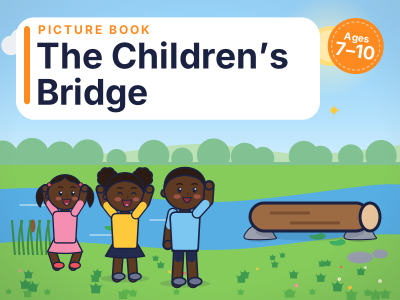
Read The Children's Bridge aloud. At the start of each paragraph, stop and ask, "Why did the author start a new paragraph here?"

  • But after the long rains... (time, and a change in the situation)
  • "We need a bridge," said Wanjiru. (a new topic: the children's idea, and a speaker)
  • After school, they built tiny bridges... (time and place)
  • They carried their model to the village meeting... (place)
  • On Saturday, half the village came... (time)
  • On Monday, Wanjiru and her friends walked across it... (time, the ending)

"Notice how often a paragraph starts with a time or place phrase. That's a strong signal to the reader that something is moving on."

Show the conventions: either indent the first line or leave a line gap between paragraphs, and stick to one.


The rest of the plan

Guided and independent practice, the plenary, assessment for learning, differentiation, common misconceptions and the home link are free with a Crayonbird account.

  1. Guided practice10 minutes
  2. Independent practice18 minutes
  3. Plenary6 minutes
  4. Assessment for learning
  5. Differentiation
  6. Common misconceptions
  7. Home link

Learning Wiki

Fact and opinion

A fact is something that can be checked and proved true or false. An opinion is what someone thinks or feels, and other people may disagree.

Inference

Inference means working out something the writer has not said directly, using clues in the text plus what you already know. It is often called reading between the lines.

Summarising

Summarising means retelling the most important ideas of a text briefly, in your own words, leaving out small details and examples.

  • English · Ages 8–9 · 55 min

    Fronted adverbials

    Children identify adverbials that tell when, where or how something happens, move them to the front of a sentence, and use a comma after a fronted adverbial.

  • English · Ages 8–9 · 60 min

    Writing a persuasive letter

    Children write a letter that persuades a real reader to agree to a request, giving clear reasons with evidence, using persuasive language and a polite letter layout.

  • English · Ages 8–10 · 55 min

    Summarising a text

    Children identify the main ideas across several paragraphs of a text and summarise them in their own words within a word limit, leaving out minor details.