Crayonbird
Menu

Science · Ages 9–10 · 55 minutes

The solar system

Children name the eight planets in order from the Sun, describe how the Earth and other planets orbit the Sun, and explain day and night as the Earth spinning.

Success criteria

  • I can name the planets in order from the Sun
  • I can explain what an orbit is
  • I can explain why we have day and night

Key vocabulary

  • solar system
  • Sun
  • star
  • planet
  • orbit
  • rotate
  • axis
  • Moon
  • dwarf planet
  • gravity

You will need

  • eight large planet name cards
  • a yellow ball or card for the Sun
  • a globe
  • a torch
  • a small sticker
  • string or chalk for the hall or playground
  • Year 5· England

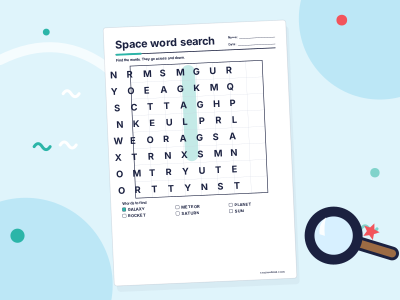
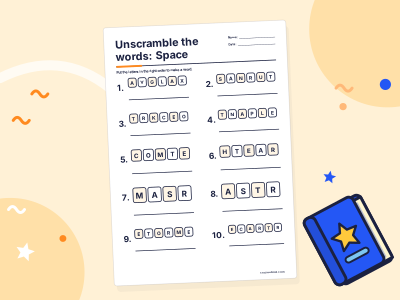
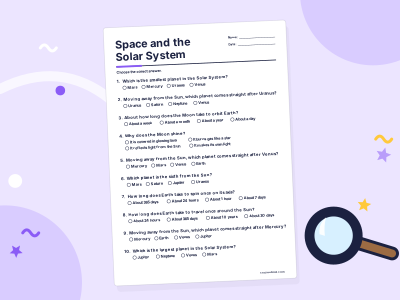
Practice sheets

Generated fresh each time you press a button, and marked instantly on screen.

The lesson at a glance

55 minutes in all. Timings are a guide: follow your class.

  1. Step 1: Starter

    Write planet, star, moon on the board.
    6 minutes
  2. Step 2: Teach

    Put the Sun in the middle of the board and add the planets in order.
    10–15 min
  3. Step 3: Guided practice

    Build a human solar system in the hall or playground.
  4. Step 4: Independent practice

    Back in class, show day and night with a torch (the Sun) and a globe with a sticker on your country.
  5. Step 5: Plenary

    Ask: "True or false: the Sun moves across the sky every day." Let children argue, then show the globe again.
  6. Step 6: Assessment for learning

    Can children name all eight planets in order?
  7. Step 7: Differentiation

    Support: give a planet strip with the first letter of each planet shown, and pair children in the human model.
  8. Step 8: Common misconceptions

    "The Sun goes round the Earth." The Earth orbits the Sun; the Sun only seems to move because the Earth spins.
  9. Step 9: Home link

    On a clear evening, look for the Moon together and notice its shape; check again a few nights later to see how it has changed.

Children often know a few planet names and some impressive facts, but the shape of the system is fuzzy: what goes round what, and why the Sun seems to move across the sky. This lesson turns the class into a moving model and then uses a globe and a torch to explain day and night.

1.Starter

6 minutes

Write planet, star, moon on the board. Ask pairs: "What is the difference between these three words? Can you give an example of each?" Take answers, then reveal: the Sun is a star; Earth is a planet; the Moon is a moon that goes round the Earth. Six minutes.

2.Teach

10–15 min

Put the Sun in the middle of the board and add the planets in order. Teach a sentence to remember them, or let the class invent one: My Very Easy Method Just Speeds Up Naming (Mercury, Venus, Earth, Mars, Jupiter, Saturn, Uranus, Neptune).

Explain the key ideas with simple script lines:

  • "The Sun is a star, and it is at the centre of our solar system."
  • "Each planet travels round the Sun on a path called an orbit. The Sun's gravity keeps the planets in their orbits."
  • "The Earth takes about a year, about 365 days, to orbit the Sun once."
  • "The Moon orbits the Earth, roughly once a month."

Then give a sense of scale: "If the Sun were the size of a football, the Earth would be about the size of a peppercorn, around 24 metres away. Neptune would be more than half a kilometre away." Ask: "Why do pictures in books show the planets close together?"

  • sun
  • planet
  • moon
  • star
  • rocket
The Sun, planets, moons and stars are very different things.

The rest of the plan

Guided and independent practice, the plenary, assessment for learning, differentiation, common misconceptions and the home link are free with a Crayonbird account.

  1. Guided practice
  2. Independent practice
  3. Plenary
  4. Assessment for learning
  5. Differentiation
  6. Common misconceptions
  7. Home link

Learning Wiki

The Moon

The Moon is Earth's natural satellite, a rocky ball about a quarter of Earth's width that orbits us roughly once a month. It shines by reflecting sunlight.

The solar system

The solar system is the Sun and everything that orbits it, including eight planets, their moons, dwarf planets such as Pluto, asteroids and comets.

Electricity

Electricity is the flow of tiny charged particles called electrons through a material. It powers lights, phones and machines, and it can come from batteries or the mains supply.

  • Science · Ages 8–10 · 55 min

    Building and reading food chains

    Children build food chains that start with a plant, use arrows to show the direction the energy goes, and identify producers, prey and predators.

  • Science · Ages 8–10 · 55 min

    Solids, liquids and gases

    Children sort materials into solids, liquids and gases using their properties, and observe ice melting as an example of a change of state.

  • Science · Ages 8–10 · 55 min

    The water cycle

    Children describe the water cycle using evaporation, condensation, precipitation and collection, and explain how the Sun's heat drives it.