Crayonbird
Menu

English · Ages 6–8 · 50 minutes

Inference - reading clues in pictures and words

Children infer how characters feel and what is happening by combining clues from pictures and words with what they already know, and explain their thinking with evidence.

Success criteria

  • I can spot clues in a picture or a sentence
  • I can say what I think and why
  • I can explain a feeling the author did not name

Key vocabulary

  • inference
  • clue
  • evidence
  • detective
  • feeling
  • I think because

You will need

  • a magnifying glass prop
  • two or three photographs or picture-book spreads with no text
  • sticky notes
  • a clue and what I know and inference chart
  • Year 2· England
  • Grade 1· United States

Practice sheets

Generated fresh each time you press a button, and marked instantly on screen.

The lesson at a glance

50 minutes in all. Timings are a guide: follow your class.

  1. Step 1: Starter

    Hold up the magnifying glass.
    7 minutes
  2. Step 2: Teach

    Draw the chart: Clue + What I know = I think...
    13 minutes
  3. Step 3: Guided practice

    Clue cards: give pairs a sentence card each.
    10 minutes
  4. Step 4: Independent practice

    Use the practice buttons.
    15 minutes
  5. Step 5: Plenary

    Each child shares one inference on a sticky note and adds it to the class chart, with the clue underlined.
    5 minutes
  6. Step 6: Assessment for learning

    Do children's because answers point to a specific word or detail?
  7. Step 7: Differentiation

    Support: start with faces and body language in pictures before moving to sentences.
  8. Step 8: Common misconceptions

    Reading figurative clues literally: "There were butterflies in his tummy." Talk about what the phrase means.
  9. Step 9: Home link

    While looking at a picture book, cover the words and ask, "How do you think this character feels?

1.Starter

7 minutes

Hold up the magnifying glass. "Today we are reading detectives. Detectives don't get told the answer. They find clues and work it out."

Describe yourself as a mystery: "I came in this morning with a wet umbrella and muddy boots. What do you think the weather was like?" Raining! "I never said it was raining. How do you know?"

"You used clues, the umbrella and the mud, plus what you know about rain. That's an inference."

2.Teach

13 minutes

Draw the chart: Clue + What I know = I think...

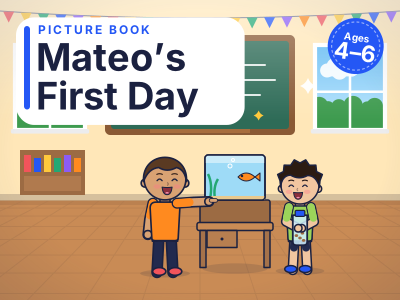
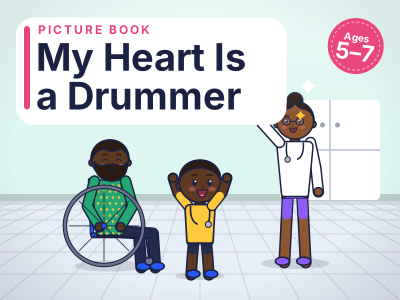
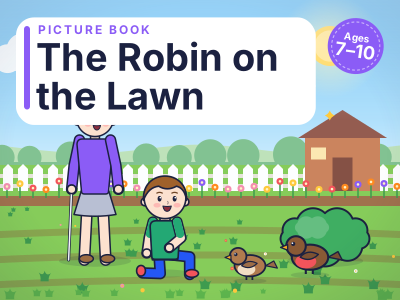
Illustration: Look closely. Who is here, what are they doing, and how might they be feeling? Point to your clue.
Look closely. Who is here, what are they doing, and how might they be feeling? Point to your clue.

Model with the scene above, thinking aloud:

"I can see... (name something in the picture). I know that... (what that usually means). So I think... (the inference)."

Then ask children for one each, always with the clue first. Push gently: "Where can you see that? Show me with your finger."

Now move from pictures to words. Write: Mateo's tummy felt full of butterflies.

"Are there real butterflies in his tummy?" No! "So what is the author telling us? How does Mateo feel?" Nervous. Worried.

"The author didn't write the word worried. We worked it out. Writers often show a feeling instead of telling us, and readers have to infer it."

Fill in the chart: Clue: tummy full of butterflies / What I know: I get a funny tummy when I'm nervous / I think: Mateo is worried about his new school.


The rest of the plan

Guided and independent practice, the plenary, assessment for learning, differentiation, common misconceptions and the home link are free with a Crayonbird account.

  1. Guided practice10 minutes
  2. Independent practice15 minutes
  3. Plenary5 minutes
  4. Assessment for learning
  5. Differentiation
  6. Common misconceptions
  7. Home link

Learning Wiki

Fact and opinion

A fact is something that can be checked and proved true or false. An opinion is what someone thinks or feels, and other people may disagree.

Inference

Inference means working out something the writer has not said directly, using clues in the text plus what you already know. It is often called reading between the lines.

Summarising

Summarising means retelling the most important ideas of a text briefly, in your own words, leaving out small details and examples.

  • English · Ages 7–8 · 50 min

    Apostrophes for possession

    Children use an apostrophe and s to show that something belongs to someone, tell possessive apostrophes apart from plurals, and begin to place the apostrophe correctly for plural owners.

  • English · Ages 6–7 · 50 min

    Joining ideas with and, because and but

    Children use the conjunctions and, because and but to join two ideas into one sentence, choosing the one that fits the meaning.