Science
What does the skeleton do?
Quick answer
The skeleton is the frame of bones inside your body. It holds you up, protects soft organs like the brain and heart, and works with muscles so you can move. Adults have 206 bones.
In one sentence
Your skeleton is the strong frame of bones inside you that holds you up, protects your organs and lets you move.
Explained
Without a skeleton you would flop like a jellyfish. Your bones do three big jobs:
- Support. Bones are the scaffolding that gives your body its shape and lets you stand up.
- Protection. Your skull is a helmet for your brain. Your ribs are a cage around your heart and lungs. Your spine (backbone) protects the spinal cord, the bundle of nerves that carries messages to and from your brain.
- Movement. Bones meet at joints, such as your knees, elbows and shoulders. Muscles attached to the bones pull on them to make them move.
Muscles can only pull, never push. So they work in pairs. When you bend your arm, the biceps on the front of your upper arm tightens and pulls. To straighten it, the triceps on the back pulls the other way. It is like a tug of war that takes turns.
Bones are alive. They have blood vessels and cells, they grow as you grow, and they can mend when they break. Inside many bones is soft marrow, which makes new blood cells.
A newborn baby has about 300 bones and bits of bone, many still partly soft cartilage. As children grow, some fuse together, so an adult has 206.

Examples
| Bone | Where | Job |
|---|---|---|
| Skull | head | protects the brain |
| Ribs | chest | protect heart and lungs |
| Spine | back | holds you upright, protects the spinal cord |
| Femur | thigh | longest bone, supports your weight |
| Stirrup (stapes) | middle ear | smallest bone, helps you hear |
 hand
hand foot
foot
Common mistakes
- "Bones are dead and dry." Living bones are full of cells and blood vessels. Only bones in museums are dry.
- "Muscles push bones." Muscles only pull, which is why they come in pairs.
- "Everyone has exactly the same number of bones." 206 is typical, but some people have an extra rib or small extra bones in their hands or feet.
Quick quiz
Skeleton
Check what you know with 4 quick questions.
Question 1 of 4
How many bones does an adult human usually have?
Practise it
Try it
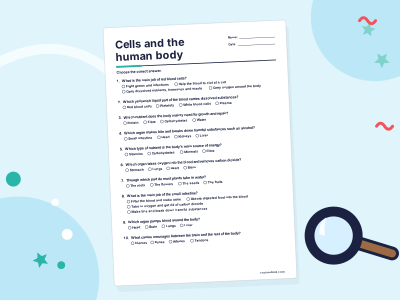
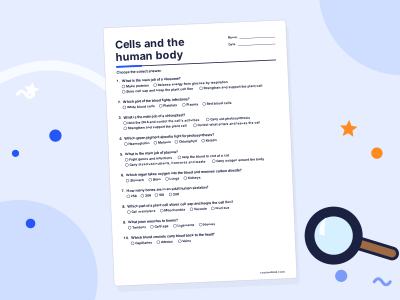
See how the skeleton fits with your other organs in the human body, then label a skeleton.
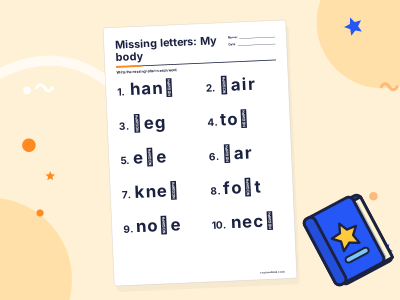
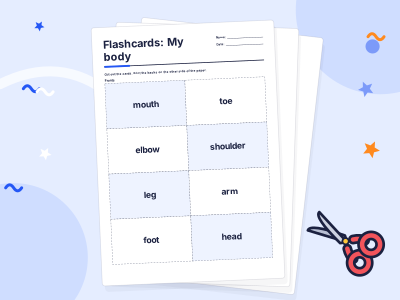
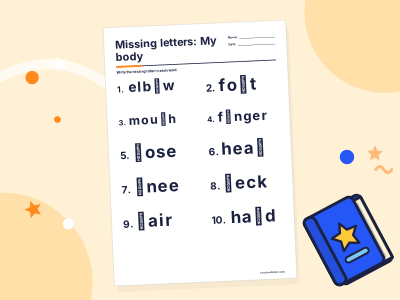
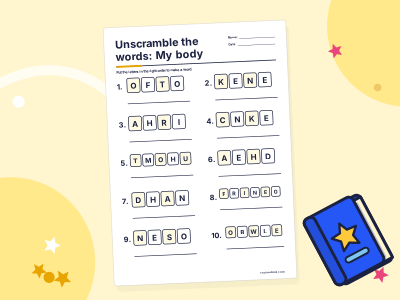
Skeleton and body worksheets
For grown-ups
Related topics
The human body
The human body is made of trillions of cells that form organs, such as the heart, lungs and brain. Organs work together in systems that keep you moving, breathing, eating and thinking.
The heart
The heart is a muscle about the size of your fist that pumps blood around your body, carrying oxygen and food to every cell and taking waste away.
Lungs
The lungs are two spongy organs in your chest that take oxygen from the air into your blood and remove carbon dioxide when you breathe out.
Healthy eating
Healthy eating means eating a variety of foods from all the main food groups, with plenty of fruit and vegetables and water to drink, so your body gets everything it needs to grow.
Digestive system
The digestive system is the long tube and organs that break food down into tiny pieces your body can absorb for energy and growth, then get rid of what is left as waste.
The senses
The five main senses are sight, hearing, smell, taste and touch. Sense organs such as the eyes, ears, nose, tongue and skin collect information and send it to your brain.