Science
What do the lungs do?
Quick answer
The lungs are two spongy organs in your chest that take oxygen from the air into your blood and remove carbon dioxide when you breathe out.
In one sentence
Your lungs are two spongy organs that pull fresh air into your body, pass oxygen into your blood and get rid of carbon dioxide.
Explained
Every cell in your body needs oxygen to release energy from food. Your lungs are where oxygen gets into your body.
When you breathe in, air goes through your nose or mouth, down your windpipe (trachea), and into two tubes called bronchi, one for each lung. These split again and again into smaller tubes, like the branches of an upside-down tree. At the very ends are hundreds of millions of tiny air sacs called alveoli, each like a microscopic balloon.
Each alveolus is wrapped in tiny blood vessels. Oxygen passes from the air in the sacs into the blood, and carbon dioxide, a waste gas made by your cells, passes from the blood into the sacs. Then you breathe it out. Your heart pumps the oxygen-rich blood around your body.
Lungs have no muscles of their own. Breathing is done by the diaphragm, a dome-shaped muscle underneath them, and muscles between your ribs. When the diaphragm pulls down and your ribs move out, the space in your chest gets bigger and air rushes in. When they relax, air is pushed out.
At rest, adults breathe roughly 12 to 20 times a minute. Exercise makes you breathe faster and deeper.

Examples
| Breathing in | Breathing out |
|---|---|
| diaphragm tightens and flattens | diaphragm relaxes and domes up |
| ribs move up and out | ribs move down and in |
| chest gets bigger, air rushes in | chest gets smaller, air is pushed out |
 nose
nose mouth
mouth balloon
Common mistakes
- "We breathe in oxygen and breathe out only carbon dioxide." Air is mostly nitrogen. Breathed-out air has a little less oxygen and a little more carbon dioxide than air breathed in.
- "The lungs push the air in and out." The diaphragm and rib muscles do the work; lungs follow.
- "Lungs are empty bags." They are spongy and full of tiny branching tubes and air sacs.
Quick quiz
Lungs
Check what you know with 4 quick questions.
Question 1 of 4
Which gas do your lungs pass into your blood?
Practise it
Try it
Place your hands on your ribs and feel them move as you breathe, then see how the body's systems work together.
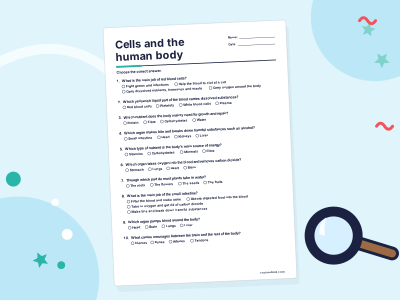
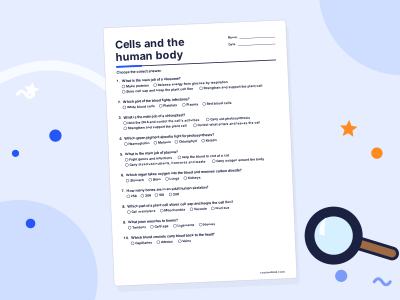
Lungs and breathing worksheets
For grown-ups
Related topics
The heart
The heart is a muscle about the size of your fist that pumps blood around your body, carrying oxygen and food to every cell and taking waste away.
The human body
The human body is made of trillions of cells that form organs, such as the heart, lungs and brain. Organs work together in systems that keep you moving, breathing, eating and thinking.
Cells
A cell is the smallest living unit. Every living thing is made of one or more cells, each with a membrane, cytoplasm and, in plants and animals, a nucleus that controls it.
Skeleton
The skeleton is the frame of bones inside your body. It holds you up, protects soft organs like the brain and heart, and works with muscles so you can move. Adults have 206 bones.
Digestive system
The digestive system is the long tube and organs that break food down into tiny pieces your body can absorb for energy and growth, then get rid of what is left as waste.
Healthy eating
Healthy eating means eating a variety of foods from all the main food groups, with plenty of fruit and vegetables and water to drink, so your body gets everything it needs to grow.