Arts
How do you draw in perspective?
Quick answer
Perspective drawing is a way to make a flat picture look three-dimensional. Things that are farther away look smaller, and parallel lines seem to meet at a vanishing point on the horizon.



In one sentence
Perspective drawing is the set of tricks artists use to show depth, so that a flat page looks like a real space.
Explained
The real world is three-dimensional, but paper is flat. Perspective is how we fool the eye. You already know some of the clues: things far away look smaller; things in front overlap things behind them; and things farther away are drawn higher up the page and often look paler.
The strongest method is linear perspective, which was worked out by Italian artists in the 1400s, such as Filippo Brunelleschi. It uses three ideas:
- The horizon line: a horizontal line at the level of your eyes where sky meets ground.
- The vanishing point: a spot on the horizon where parallel lines going away from you seem to meet. Think of railway tracks that appear to join in the distance.
- Guidelines (orthogonals): the lines you draw from objects to the vanishing point.
 pencil
 ruler
 house
Here is how to draw a box in one-point perspective.
Step by step
- Draw the horizon.Use a ruler to draw a straight line across the page.
- Mark the vanishing point.Put a dot on the horizon line.
- Draw the front face.Make a square or rectangle below or above the line.
- Connect the corners.Use light pencil lines from each corner to the vanishing point.
- Draw the back.Add a smaller square between those lines, with edges parallel to the front.
- Rub out the extra lines.Darken the edges you want to keep.
In two-point perspective, you use two vanishing points on the horizon, and a corner of a building faces you. This is good for houses and street scenes. The edges that are upright stay straight up and down. Both rely on your skill in drawing 2D shapes, and practice with a ruler helps. Perspective was an important part of the Renaissance. Pairing it with colour adds distance too: far things are paler and cooler.
Examples
| Type | Vanishing points | Good for |
|---|---|---|
| One-point | 1 | roads, corridors, railway tracks |
| Two-point | 2 | buildings seen from a corner |
| Three-point | 3 | tall buildings seen from above or below |
Common mistakes
- Horizon too high or low. It should match the eye level of the viewer.
- Lines not meeting at the vanishing point. Use a ruler and light pencil.
- Drawing the back of a box the same size as the front. It should be smaller.
Quick quiz
Perspective drawing
Check what you know with 4 quick questions.
Question 1 of 4
Where do parallel lines seem to meet in a perspective drawing?
Practise it
Try it
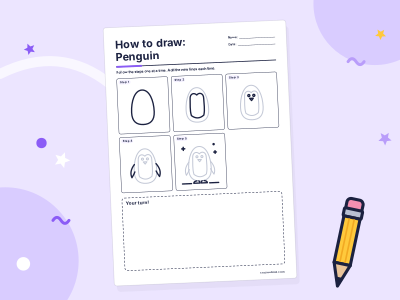
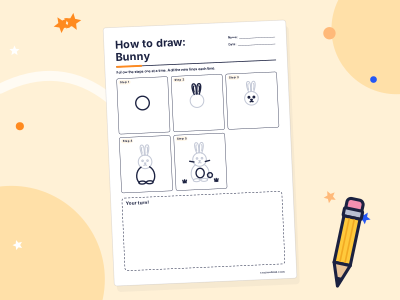
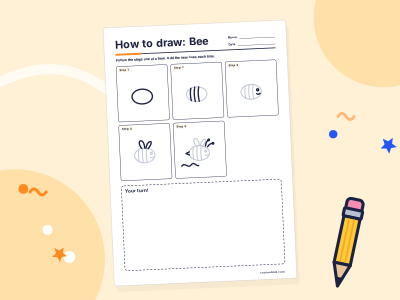
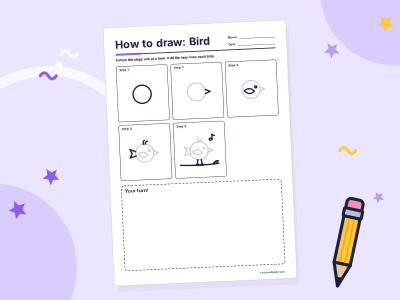
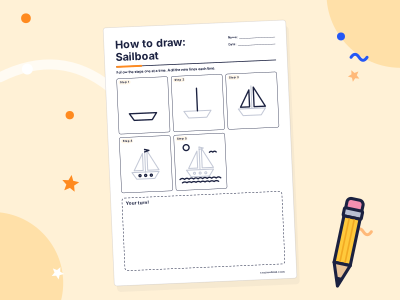
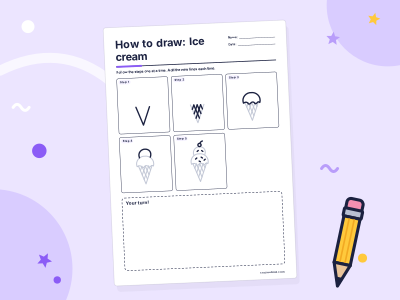
How to draw practice
For grown-ups
Related topics

The colour wheel
The colour wheel is a circle that arranges colours to show how they relate. Colours opposite each other, like blue and orange, are complementary and make strong contrast.

2D shapes
2D shapes are flat shapes with length and width but no thickness, like circles, triangles, squares and hexagons. You can draw them on paper.

Symmetry
A shape has symmetry when one half is a mirror image of the other (line symmetry), or when it looks the same after being turned (rotational symmetry).

Musical instruments
Musical instruments make sound in different ways: by plucking or bowing strings, blowing air, or hitting. In an orchestra they are grouped as strings, woodwind, brass and percussion.

Musical notes
Musical notes are written symbols that show which sound to play and for how long. Their position on a five-line staff gives the pitch, and their shape gives the length.
Primary and secondary colours
Red, yellow and blue are the primary colours in painting: you cannot make them by mixing. Mixing two primaries gives a secondary colour: orange, green or purple.