English
What are homophones?
Quick answer
Homophones are words that sound the same but have different meanings and usually different spellings, like there, their and they're, or see and sea.
In one sentence
Homophones are words that sound exactly alike but mean different things, and are usually spelt differently.
Explained
The word comes from Greek: homo means "same" and phone means "sound". Say knight and night aloud. You cannot hear any difference, yet one is a soldier on horseback and the other is the dark part of the day.
Because they sound the same, homophones cause spelling mistakes rather than speaking mistakes. The only way to choose is to think about the meaning in the sentence.
The famous trio:
- there = a place, or with is / are: Put it over there. There is a cat.
- their = belonging to them: They lost their keys.
- they're = they are: They're late. (The apostrophe shows the missing a.) See apostrophes.
Another tricky set:
- to = towards, or before a verb: go to school, to swim
- too = also, or more than enough: me too, too hot
- two = the number 2
Memory tricks help. Here and hear: you hear with your ear. Where and wear: where asks about a place, like here and there.
Some words are near-homophones: they sound similar but not identical, such as accept / except or quiet / quite. And homophones can depend on accent. In some accents pour and poor sound the same; in others they do not.
Do not confuse homophones with homographs, which are spelt the same but have different meanings and sometimes different sounds: a tear in my eye / a tear in my shirt.
 bee
bee bear
bear wave
wave
Examples
| Homophones | Meanings |
|---|---|
| see / sea | look / salt water |
| hear / here | listen / this place |
| which / witch | question word / magic person |
| weather / whether | rain or sun / if |
| son / sun | a boy child / the star |
| blue / blew | a colour / past of blow |
| piece / peace | a part / calm |
Common mistakes
- Your / you're. If you can say you are, write you're.
- Spellcheckers miss them. I red the book has no spelling error to a computer, but it should be read. Proofread for meaning.
- Mixing them up with synonyms. Synonyms share meaning; homophones only share sound.
Quick quiz
Homophones
Check what you know with 4 quick questions.
Question 1 of 4
Which word completes the sentence? The children put on ___ coats.
Practise it
Try it
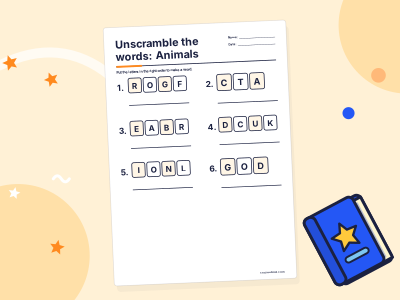
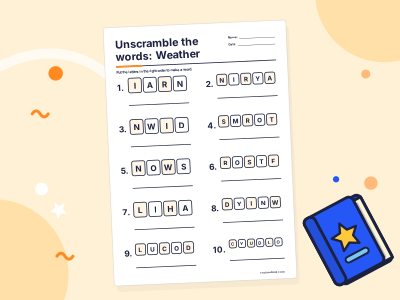
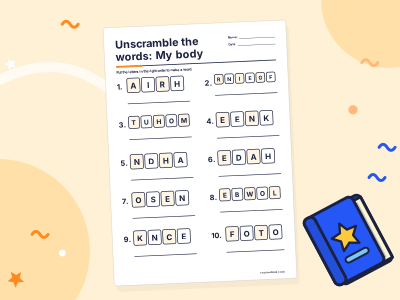
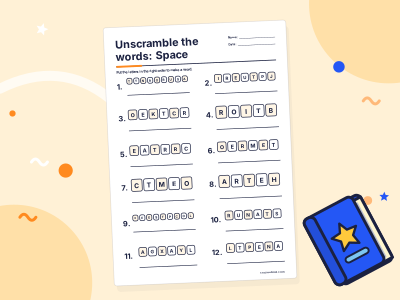
Spelling practice for tricky words
For grown-ups
Related topics
Synonyms
A synonym is a word that means the same or nearly the same as another word, like big and large, or happy and cheerful.
Apostrophes
An apostrophe has two jobs. It shows where letters are missing in a contraction (can't, it's) and shows that something belongs to someone (the dog's bone, the girls' team).
Rhyme
Words rhyme when their ending sounds match, like cat and hat, or light and bite. Rhymes depend on sound, not spelling.
Plurals
A plural means more than one. Most nouns add -s (cats) or -es (boxes), but some change in other ways, like babies, leaves, mice and children.
Prefixes
A prefix is a group of letters added to the start of a word to change its meaning, like un- in unhappy, re- in replay or dis- in disappear.
Suffixes
A suffix is a group of letters added to the end of a word to change its meaning or job, like -ful in helpful, -ness in kindness or -ed in jumped.