Geography
What are the continents?
Quick answer
Continents are the very large areas of land on Earth. In English-speaking schools you usually learn seven, but some countries count six.
In one sentence
A continent is one of the very large areas of land that Earth's surface is divided into.
Explained
Look at a globe and you will see a lot of blue sea and a few huge pieces of land. Geographers group that land into continents. Each continent contains many countries, apart from Antarctica, which has none.
In the UK, the US, Nigeria, India, China, Australia and many other places, children learn seven continents: Africa, Antarctica, Asia, Australia (often called Oceania), Europe, North America and South America.
But there is no single world rule, and that surprises many people. In much of Latin America, Spain, Portugal and Italy, schools teach six continents, because North and South America are counted as one continent called America. In Russia and some other places, Europe and Asia are often joined as Eurasia, since they sit on one connected piece of land. The five rings on the Olympic flag stand for five inhabited continents, leaving out Antarctica. None of these answers is "wrong"; they are different conventions. Where Europe stops and Asia begins is also a choice people agreed on, usually along the Ural Mountains.
 globe
globe map
map penguin
 camel
camel
Examples
The seven continents from biggest to smallest by area:
| Continent | One country there | Something to know |
|---|---|---|
| Asia | India | largest, and home to most of the world's people |
| Africa | Nigeria | 54 countries, more than any other continent |
| North America | Mexico | includes Central America and the Caribbean |
| South America | Brazil | the Amazon rainforest is here |
| Antarctica | none | covered in thick ice |
| Europe | France | small in area but has many countries |
| Australia / Oceania | Fiji | includes Australia, New Zealand and Pacific islands |
Common mistakes
- "Africa is a country." It is a continent. Say the country's name instead, such as Ghana or Ethiopia.
- "There are definitely seven continents." Seven is common, but six is just as normal in many countries. Know both.
- Mixing up continents and oceans. Continents are land; oceans are the huge bodies of salt water between them.
Quick quiz
Continents
Check what you know with 4 quick questions.
Question 1 of 4
Which is the largest continent?
Practise it
Try it
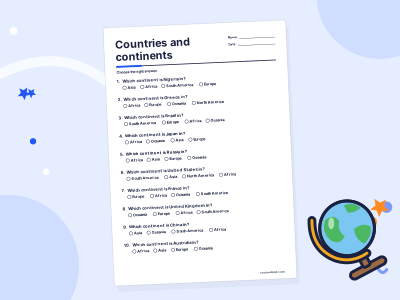
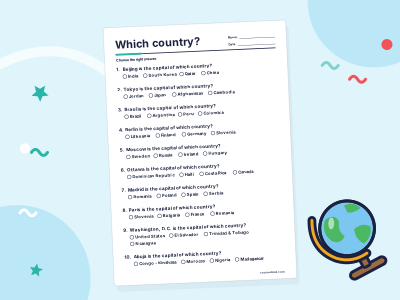
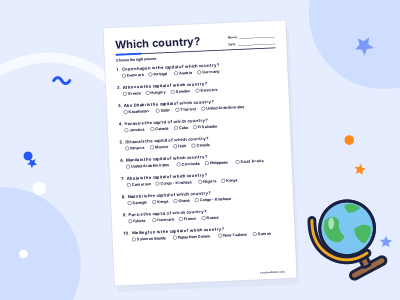
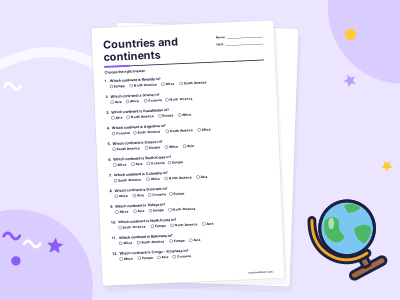
Countries and continents practice
For grown-ups
Related topics
Oceans
Oceans are the huge bodies of salt water that cover most of Earth. There are five: the Pacific, Atlantic, Indian, Southern and Arctic.
Countries
A country is an area of land with its own borders, government and laws. Most lists count 195 countries in the world today.
Capital cities
A capital city is the city where a country's government is based. It is not always the biggest city: Nigeria's capital is Abuja, not Lagos.
Maps
A map is a drawing of a place seen from above. A key explains its symbols, a scale shows real distances and a compass shows direction.
Climate
Climate is the usual pattern of weather in a place over many years, usually 30 or more. Weather is what is happening in the sky today.
Compass directions
The four main compass directions are north, east, south and west. Between them are northeast, southeast, southwest and northwest.