Computing
What is binary?
Quick answer
Binary is a number system that uses only two digits, 0 and 1. Computers use binary to store and process all their information.
In one sentence
Binary is a way of writing numbers using only 0 and 1, and it is the language computers use inside.
Explained
We usually count in base 10, using ten digits from 0 to 9. Each column is worth ten times the one to its right: ones, tens, hundreds. That idea is place value.
Binary is base 2. It has only two digits, 0 and 1, and each column is worth double the column to its right: 1, 2, 4, 8, 16, 32, 64, 128. Those are the powers of 2. To read a binary number, add up the values of the columns that have a 1.
Why do computers use it? Inside a computer chip are billions of tiny switches called transistors. Each can be off (0) or on (1). With enough of them, computers can store any number. Letters, colours, sounds and pictures are all turned into numbers too, so in the end everything on your screen is binary. When you write code, the computer translates it into binary instructions it can follow.
One binary digit is a bit. Eight bits make a byte, which can store any number from 0 (00000000) to 255 (11111111).
 lamp
lamp lightning
 computer
 star
star
Examples
Column values for 4 bits: 8, 4, 2, 1
| Binary | Working | Number |
|---|---|---|
| 0001 | 1 | 1 |
| 0010 | 2 | 2 |
| 0011 | 2 + 1 | 3 |
| 0101 | 4 + 1 | 5 |
| 1000 | 8 | 8 |
| 1010 | 8 + 2 | 10 |
| 1111 | 8 + 4 + 2 + 1 | 15 |
Turning a number into binary: to write 13, start with the biggest column that fits. 8 fits (13 − 8 = 5), then 4 fits (5 − 4 = 1), 2 does not, 1 fits. So 13 = 1101.
Common mistakes
- Reading "10" as ten. In binary, 10 means one 2 and no 1s: two.
- Columns in the wrong order. The smallest column (1) is always on the right.
- Adding instead of doubling. Columns go 1, 2, 4, 8, 16, not 1, 2, 3, 4.
Quick quiz
Binary
Check what you know with 4 quick questions.
Question 1 of 4
What is the binary number 101 in our usual numbers?
Practise it
Try it
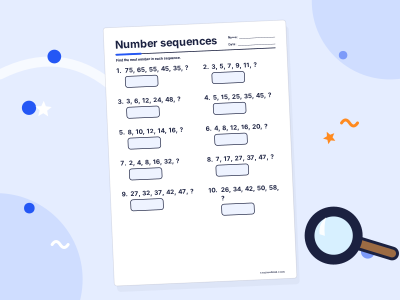
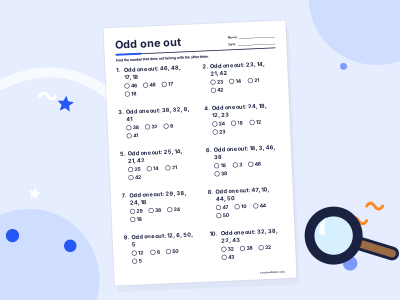
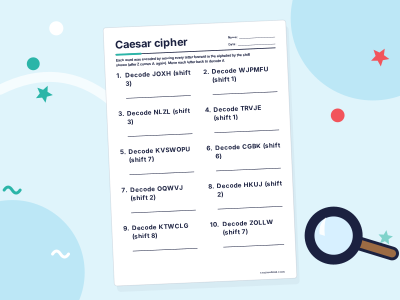
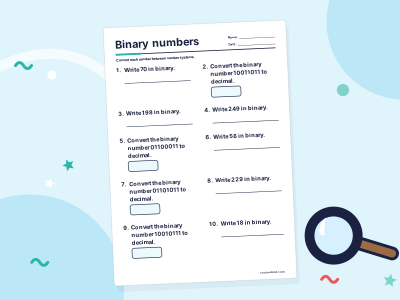
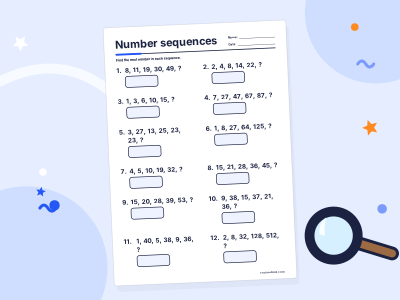
Count from 0 to 15 in binary on your fingers: each finger is a column (1, 2, 4, 8), up means 1. Then crack some codes:
Code-breaking and logic puzzles
For grown-ups
Related topics
Place value
Place value means a digit's value depends on its position in a number. In 352, the 3 is worth 300, the 5 is worth 50 and the 2 is worth 2.
Coding
Coding, or programming, means writing instructions in a language a computer understands so it can do a job, like run a game, an app or a website.
Powers and indices
A power (also called an index or exponent) is a small raised number showing how many times to multiply a number by itself. So 2⁴ means 2 × 2 × 2 × 2 = 16.
Algorithm
An algorithm is a precise, step-by-step set of instructions for solving a problem or doing a task. Computers follow algorithms written as code.
Debugging
Debugging means finding and fixing mistakes, called bugs, in an algorithm or a computer program. It is a normal part of coding for everyone.
Growth mindset
A growth mindset is the belief that abilities can improve with practice, good strategies and help. A fixed mindset is the belief that you either have a talent or you don't.