Early Finisher Activities That Aren't Just More Worksheets
A simple classroom system for early finishers, with meaningful task ideas, extension that goes deeper rather than wider, and fixes for rushing and noise.
On this page
Every teacher knows the moment: a hand goes up four minutes into a twenty-minute task, and a voice says "I've finished". What happens next matters more than it seems. Hand over another sheet of the same sums, and that child learns that finishing quickly earns more work. Let them wander, and the room starts to drift. Here's a system that gives early finishers something worth doing, without creating extra planning every day.
Why "more of the same" backfires
The quickest fix is the extra worksheet: "Well done, here's another one." It solves the next five minutes and creates three problems.
It punishes efficiency. Children notice that finishing first means more work. Some respond by slowing down on purpose. You've just taught your fastest workers to dawdle.
It doesn't stretch anyone. A child who got twenty sums right doesn't need twenty more. They've shown they can do it. What they need is a harder or different kind of thinking.
It confuses fast with finished. Many early finishers haven't actually finished. They've reached the end. Their work may be rushed, unchecked or missing the second half of the question.
A good early finisher system deals with all three: it checks the work first, offers tasks that are genuinely interesting, and gives the strongest learners depth rather than volume.
First, check the work is really finished
Before any child moves on, they go through a short checklist. Put it on the wall and on a card on each table.
Am I really finished?
- I have answered every question, including the back of the sheet
- I have checked my answers (or done one again a different way)
- My name and the date are on it
- I can explain my work if the teacher asks
- My handwriting can be read by someone else
Then spot-check. Walk over, pick one answer and ask "How did you get that?" If the child can explain, they're done. If not, they go back. Within a couple of weeks, rushing drops sharply, because children learn that a rushed sheet doesn't get them anywhere faster.
Build a "May Do" system
The simplest system that works is the Must Do / May Do board. "Must Do" is today's task. "May Do" is a short list of options children can choose from once they've finished properly. The options stay the same for a few weeks, so nobody needs instructions.
Step by step
- Pick four or five categoriesFor example Think, Read, Create, Write and Maths. Give each one an icon so younger children can read the board.
- Set up a station or tubsOne tub or folder per category on a shelf children can reach. Task cards, puzzle pages and materials live there.
- Teach the rules onceWork quietly, work alone or with one partner, put things back, and stop when the class stops.
- Rotate monthlySwap the contents of each tub every three or four weeks. The categories stay the same; the activities change.
- Track lightlyA simple tally sheet in each tub shows what's popular and which children never use it.
 puzzle
 book
book crayon
 blocks
 magnifying glass
 scissors
A menu of meaningful tasks
Here's what to put in each tub. Every idea works independently, with little or no marking.
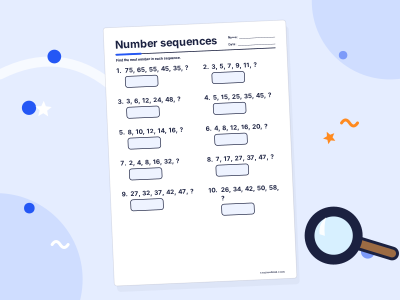
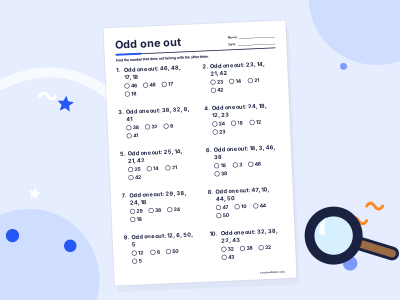
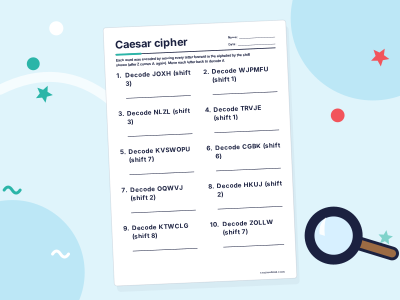
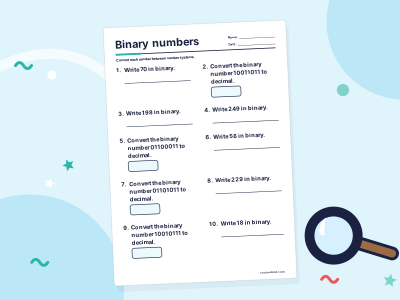
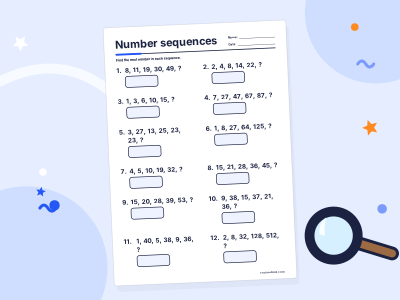
Think. Logic puzzles, mazes, sudoku, spot-the-difference and riddles. These build reasoning and persistence. Start with puzzles slightly too easy, so children experience success before frustration. Our logic and brain teaser pages are graded by difficulty, and the free Puzzle Mania Book makes a ready-made tub on its own. For why this matters, see our post on the benefits of puzzles.
Read. A small basket of short books, comics and non-fiction, plus "book review cards": Title, three stars or five?, one sentence on why. Reviews can go on a class display that others use to choose books.
Create. Step-by-step drawing lessons, comic-strip templates, a "design a new animal" sheet. Drawing a robot in six steps sounds like a break, but it's sequencing, careful looking and fine motor control.

Write. Story starters on cards ("The door at the back of the library had never been opened, until…"), letters to an author, a "list of ten" card (ten things you'd pack for the moon, ten words that describe the sea).
Maths. Open-ended problems with many answers:
- How many different ways can you make 20p (or 20 cents) with coins?
- Find three numbers that add up to 50. Now find three that multiply to 24.
- Draw a shape with a perimeter of 12 squares. Draw a different one.
- Make the largest and smallest numbers you can with the digits 3, 7, 0 and 5.
None of these has a single right answer, so a quick child can keep going and keep finding more.
Logic puzzles for the Think tub
Extension that goes deeper, not wider
Some children finish early almost every lesson. For them, the May Do board is a bonus, but the real fix is extending the task itself.
Instead of a new activity, ask them to go further with the one they just did:
- Prove it. "You found that 6 × 4 = 24. Prove it with a drawing, and then a different way."
- Make your own question. "Write a word problem that uses this sum, and an answer card for it." Their problems can become next week's morning work.
- What if… "What if the triangle had a right angle? What if the story was told by the wolf?"
- Find the rule. "You've added these pairs. What do you notice about odd plus odd? Does it always work?"
- Teach it. "Write a three-step guide for a younger child on how to do this." Explaining shows depth of understanding.
You can write these as a small set of generic "challenge cards" that work with almost any task. Hand one over with the instruction "Use this on the work you just did."
For more on planning tasks at several levels from the start, see our guide to differentiation in a mixed-ability classroom.
Task cards you can copy today
If you want to start straight away, write these on index cards, number them, and put them in a box. Each one works for most children aged 7–11 with no extra materials beyond paper and a pencil.
- Write the alphabet down the side of a page. Find an animal for every letter. Which letters were impossible?
- Draw a map of your dream bedroom from above. Add a key.
- Write five questions you'd ask the author of the book you're reading.
- Using only the digits 1, 2, 3 and 4 once each, how many different two-digit numbers can you make?
- Invent a new sport. Write the three most important rules.
- Write a short story in exactly 50 words. Count carefully.
- Draw a creature that lives at the bottom of the sea. Label how it finds food in the dark.
- Make a list of ten things in the classroom that are shaped like rectangles. Then ten circles.
- Write a riddle about an object in the room. Can a friend guess it?
- Design a stamp for your country or town. What picture would you choose, and why?
For younger children (5–7), turn the same ideas into picture cards: "Draw 3 things that are red", "Find 5 things in the book corner that start with b", "Build a tower with 10 blocks and draw it".
Early finishers by age
Ages 5–7. Keep it visual and hands-on. Picture task cards instead of written instructions, tubs with puzzles, playdough letter mats, simple colouring, picture books, and threading or building tasks for fine motor work. Two or three tubs is plenty. Teach each tub explicitly before it goes on the shelf.
Ages 8–11. Children can handle longer, self-directed projects. An "ongoing project" folder lets them return to the same piece of work over several weeks: researching an animal, writing a chapter book, designing a theme park with a budget, making a class newspaper. These projects grow, so the child who finishes early ten times in a month has something substantial at the end of it.
Common problems and how to fix them
"They rush to get to the fun stuff." Use the "Am I really finished?" checklist, and spot-check quality. Make May Do tasks available at other times, too, such as a Friday afternoon slot for everyone, so they aren't only a prize for speed.
"It's too noisy." Limit the station to two or three children at a time, with a "station is full" sign. Choose quiet categories for small spaces.
"The same three children always use it." That's normal for the first few weeks. But check the tally sheets. If slower workers never get there, give them access at another time. Children who take longer deserve interesting tasks too, and sometimes they are the ones who love logic puzzles most.
"I don't have time to make all this." You don't need to. Start with one tub, a puzzle folder, and add one more every few weeks. A pile of printed puzzle pages and a basket of books is a perfectly good start.
"Some children just want to help me." Helping can be fine occasionally, but early finishers shouldn't become your unpaid assistants. They need challenge too.
This week, set up one tub, the Think tub, with ten puzzle pages and a laminated "Am I really finished?" card. Introduce it on Monday, and add a second tub next week. For pages ready to print, start with our early finishers collection.
Print early finisher activities
Common questions
What should early finishers do in class?
Something meaningful they can do independently and quietly: logic puzzles, reading, drawing lessons, open-ended maths challenges or an ongoing project. Avoid simply handing out another worksheet of the same thing.
How do I stop children rushing to get to the early finisher activities?
Add a short "Am I really finished?" checklist before they can choose, and check quality, not just completion. Make early finisher tasks available at other times too, so they are not only a reward for speed.
Should early finishers help other students?
Sometimes, if they explain well and the other child wants help. But it shouldn't be their default job, as they also need to be stretched, and peer tutoring works best when it's planned.
Printables used in this article

Crayonbird Editorial Team
Writers, illustrators and educators
We are the small team that writes, draws and tests Crayonbird’s activities. We try every idea with our own printables, keep advice practical and honest about what doesn’t work, and point to official guidance where it matters. Nothing on this blog is sponsored.
Related articles
Teaching tips
Differentiation in a Mixed-Ability Classroom: A Practical Guide
Practical differentiation for primary teachers: one learning goal, three-level worksheets, scaffolds that fade, flexible grouping and extension that adds depth.
Ages 5–118 min read
Teaching tips
Morning Work Ideas for Primary Classrooms: Routines and Bell-Ringers
Calm, low-prep morning work for primary teachers: how to set up the routine, a week of ideas, differentiated options and bell-ringers for ages 5–11.
Ages 5–118 min read
Art and creativity
The Real Benefits of Colouring for Children (and How to Get More from It)
What colouring genuinely does for children's hands, focus and calm, what it doesn't, and simple ways to turn a colouring page into a learning activity.
Ages 2–108 min read