Morning Work Ideas for Primary Classrooms: Routines and Bell-Ringers
Calm, low-prep morning work for primary teachers: how to set up the routine, a week of ideas, differentiated options and bell-ringers for ages 5–11.
On this page
The first fifteen minutes of the school day set the tone for the rest of it. Children arrive in a trickle, someone has a note about lunch, someone else has a wobbly tooth to show you, and the register still needs doing. Good morning work turns that time into a calm, predictable start where children practise something useful without needing you. Here is how to set it up, a full week of ideas, ways to differentiate without tripling your prep, and the things that quietly make morning work worse.
What morning work is for (and what it isn't)
Morning work, also called bell-ringers, early work or soft start, has three jobs:
- Settle the room. Children walk in, know exactly what to do, and start.
- Review, not teach. It practises skills they've already learnt: number facts, spellings, handwriting, a bit of reading.
- Free you up. While children work, you take the register, check in with a child who looks upset, or hear two readers.
It isn't a time for new content, long tasks or anything that needs explaining. If you have to stand at the front and give instructions, it's a lesson, not morning work. Aim for ten to fifteen minutes and tasks that 80–90% of the class can do without help.
Setting up the routine
The routine matters more than the activities. A brilliant worksheet handed out in a different way every day causes more chaos than a plain one handed out the same way.
Step by step
- Same place, every dayPut morning work on desks before the children arrive, or in a tray by the door they collect from. The location should never change.
- Instructions on the board, not out loudA short visual: "1. Hang up your coat. 2. Book bag in tray. 3. Morning work. 4. Finished? Read." Point to it instead of repeating it.
- Start the moment they arriveThe work is there before the first child walks in, so nobody waits.
- Have a fixed "finished" optionReading, a puzzle book or a drawing journal. Children shouldn't need to ask what's next.
- Use the time yourselfRegister, lunch choices, one-to-one reading, a quiet word with a child who needs it.
- Close it the same wayA two-minute signal ("Pencils down, eyes on me"), then go over one question together.
Spend the first two weeks of term teaching the routine itself. Practise walking in and starting. Praise specific things: "Amara sat down and started without being asked." By October, it runs itself.

A week of morning work
Having a theme for each day cuts your planning in half. Children also know what to expect, which helps the anxious ones and the ones who find transitions hard.
| Day | Focus | Ages 5–7 (Year 1–2 / K–grade 1) | Ages 8–11 (Year 3–6 / grades 2–5) |
|---|---|---|---|
| Monday | Maths review | Count and write the number before and after: __ 14 __ | Number of the day: 348. Double it, halve it, round to the nearest 10 and 100 |
| Tuesday | Word work | Missing letters: c_t, d_g, s_n | Add a suffix: hope → hopeful, hopeless, hoping |
| Wednesday | Writing | Draw and label your breakfast | Finish the story: "When I opened the lunchbox, it wasn't my lunch…" |
| Thursday | Puzzles and logic | A simple maze or spot the difference | A logic grid or a sudoku |
| Friday | Fix it and free choice | Fix the sentence: the cat sat on the mat | Fix the sentence: their going too the park on saturday |
Friday's "fix it" sentence is a favourite in most classrooms: children enjoy hunting for errors more than writing from scratch. For the 8–11 version above there are four errors to find: They're, to, Saturday, and the missing full stop.
For a ready-made month of Year 1 / grade 1 pages, the Morning Work: Month 1 (Grade 1) pack gives twenty short daily pages with a few sums, missing letters and a word to trace.
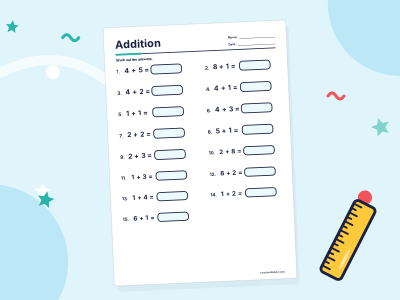
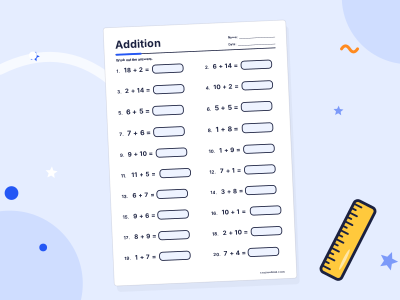
Quick addition pages for Monday maths
Differentiated options without tripling your prep
Every class has a range. Some children finish in four minutes, others are still writing their name. You don't need three different worksheets every day to deal with that.
One task, three entry points. Put the same task at three levels on a single sheet, labelled with shapes rather than words: a circle, a triangle, a star. Children start where you've suggested (or where they choose), and can move up.
For a "number of the day" with the number 24:
- Circle: Draw 24 with tens and ones. What comes before and after?
- Triangle: Write 24 as a sum in three different ways. Is it odd or even?
- Star: Find all the pairs of numbers that multiply to make 24.
Open-ended prompts. Tasks with no single right answer differentiate themselves. "Write as many number sentences as you can that equal 10" works for a child writing 5 + 5 and a child writing 100 ÷ 10.
Choice boards. On Fridays, offer three or four options and let children choose. They often pick the harder one when it looks more interesting.
Our post on differentiation in a mixed-ability classroom goes into the three-level worksheet in more detail.
Low-prep ideas that work every time
Not every morning needs a new worksheet. These ideas take a minute to set up on the board.
- Number of the day. Write a number. Children do as much as they can with it: add 10, take away 1, draw it, write it in words.
- Fix the sentence. One sentence with a few deliberate errors.
- Picture prompt. Show an interesting image and ask for three sentences: what's happening, what happened before, what happens next.
- Would you rather. "Would you rather live in a lighthouse or a treehouse? Give two reasons." Good for opinion writing.
- Word ladder. Change one letter at a time: cat → cot → dot → dog.
- Estimation. "How many pencils are in the jar?" Children write a guess and a reason, and you reveal the answer at the end.
- Handwriting line. One line of a letter join or a tricky letter, done carefully.
- Quick draw. A step-by-step drawing on the board, one step at a time. It settles even the busiest class.
- Journal entry. A sentence or two about the weekend, a picture with labels for younger ones.

Bell-ringers for older primary
From around age 9, morning work can do more serious review work, especially for things you want to stay fresh.
Retrieval questions. Five quick questions on things from last week, last month and last term. "What is 7 × 8? What's a noun? Name two things plants need to grow. What's the capital of Kenya? How many millilitres in a litre?" Going back to older topics keeps them alive.
Explain the mistake. Show a worked answer with an error: "34 + 28 = 52". Children find the mistake and explain it (they forgot to carry the ten; it should be 62). This builds understanding, not just accuracy.
True or false? "All rectangles are squares." "Half of 50 is 25." Children write T or F and one sentence of reasoning.
Mental maths warm-up. Ten quick-fire questions on one strategy, like near doubles or adding 9 by adding 10 and taking 1. Our guide to mental maths strategies has more starters like this.
 pencil
 clock
clock book
book globe
globe ruler
ruler board
board
A fifteen-minute morning, minute by minute
Here's what a settled routine can look like in practice, for a class of about thirty.
- 8:45 — doors open. You stand at the door greeting children by name. The board says: Coat, bag, book bag, morning work. Finished? Read. Today's sheet is already on every desk.
- 8:47 — most children are working. A few late arrivals and a parent with a message. You point to the board rather than repeating the instructions.
- 8:50 — register and lunches, done quietly while children work. Two children who need a little reassurance get a quick word.
- 8:53 — one-to-one time. You hear one child read, or check in with a child who struggled yesterday.
- 8:57 — early finishers move to reading without asking. You walk the room and glance at answers.
- 9:00 — signal. "Pencils down in one minute." Then: "Let's look at question three together. Who found the mistake in the sentence?"
- 9:02 — into the first lesson.
The whole thing works because nothing in it is new. Children know where the work is, what to do with it, and what comes next, so your attention can go to the children who need it.
What to avoid
A few common habits quietly undo the benefits.
Colouring sheets every day. Colouring has real value, but on its own every morning it soon becomes filler. Use it as a finished option or on Friday, not as the main task.
New content. If half the class needs your help to start, it's too hard for morning work. Save new learning for lessons, when you're teaching.
Marking everything. You don't need to mark every morning task. Put answer cards on a table for self-checking, go over one question together, or collect and look at a sample of five books each day.
Long tasks. If morning work regularly runs into the first lesson, it's too long. Cut it down rather than extending the time.
Punishing unfinished work. Children who arrive late or slowly shouldn't miss break to finish morning work. It's a soft start, not a test.
This week, choose one routine change: put the work on desks before the children arrive and write the four-step instructions on the board. Next week, add day themes. For printable pages to fill the slots, browse our morning work collection or the teachers' area.
Print morning work pages
Common questions
How long should morning work take?
About ten to fifteen minutes. It should be short enough that most children can finish it independently while you take the register and greet arrivals.
Should morning work be marked?
Not every day. Use self-check answer keys, mark a sample, or go over one question together. Light, regular feedback is more useful than piles of marking.
What should children do if they finish morning work early?
Give them a fixed, familiar option such as silent reading, a puzzle or a drawing journal, so they don't need to ask you what to do next.
Printables used in this article

Crayonbird Editorial Team
Writers, illustrators and educators
We are the small team that writes, draws and tests Crayonbird’s activities. We try every idea with our own printables, keep advice practical and honest about what doesn’t work, and point to official guidance where it matters. Nothing on this blog is sponsored.
Related articles

Teaching tips
Differentiation in a Mixed-Ability Classroom: A Practical Guide
Practical differentiation for primary teachers: one learning goal, three-level worksheets, scaffolds that fade, flexible grouping and extension that adds depth.
Ages 5–118 min read

Teaching tips
Early Finisher Activities That Aren't Just More Worksheets
A simple classroom system for early finishers, with meaningful task ideas, extension that goes deeper rather than wider, and fixes for rushing and noise.
Ages 5–118 min read

Art and creativity
The Real Benefits of Colouring for Children (and How to Get More from It)
What colouring genuinely does for children's hands, focus and calm, what it doesn't, and simple ways to turn a colouring page into a learning activity.
Ages 2–108 min read