Geography
What is a mountain and how do mountains form?
Quick answer
A mountain is a very high landform with steep sides and a peak. Most form when tectonic plates push together or when volcanoes build up.
In one sentence
A mountain is a large, high part of Earth's surface with steep slopes that rises well above the land around it.
Explained
Earth's outer layer is broken into giant slabs called tectonic plates. They move very slowly, a few centimetres a year, about as fast as your fingernails grow. Over millions of years, that movement builds mountains.
Fold mountains form when two plates push together and the rock crumples upwards, like a rug pushed against a wall. The Himalayas, the Alps and the Andes formed this way. The Himalayas are still rising, because India keeps pushing into the rest of Asia. Volcanic mountains grow as lava and ash pile up during eruptions; Kilimanjaro and Mount Fuji are examples (see volcanoes). Block mountains form when cracks in the crust let huge blocks of land rise or sink.
There is no single world rule for when a hill becomes a mountain. Generally, mountains are higher and steeper and have a clear top, or peak. A line of mountains is a range.
Mountains have their own weather. Air gets colder as you go higher, so peaks can be covered in snow even in hot countries. Many rivers begin as rain or melting snow on mountains.
Highest or tallest? Mount Everest, on the border of Nepal and China, is the highest above sea level at 8,848.86 m. But Mauna Kea in Hawaii starts deep under the ocean. Measured from its base on the sea floor, it is over 10,000 m, taller than Everest.

Examples
| Mountain | Continent | Height above sea level |
|---|---|---|
| Everest | Asia | 8,849 m |
| Aconcagua | South America | about 6,960 m |
| Denali | North America | about 6,190 m |
| Kilimanjaro | Africa | about 5,895 m |
| Mont Blanc | Europe | about 4,800 m |
Common mistakes
- "Mountains never change." They grow as plates push and wear down as wind, ice and rain break up the rock.
- "Highest" and "tallest" mean the same. Highest means highest above sea level; tallest means from base to peak.
- Thinking all mountains were volcanoes. Many are folded rock, like the Himalayas.
Quick quiz
Mountains
Check what you know with 4 quick questions.
Question 1 of 4
What is the highest mountain above sea level?
Practise it
Try it
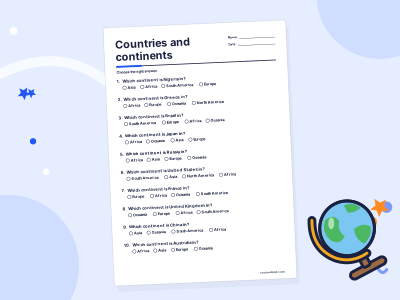
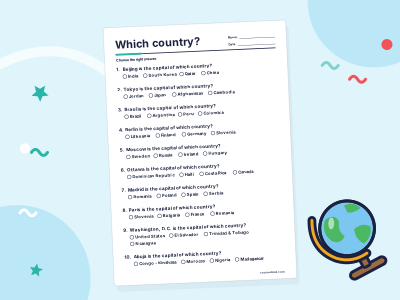
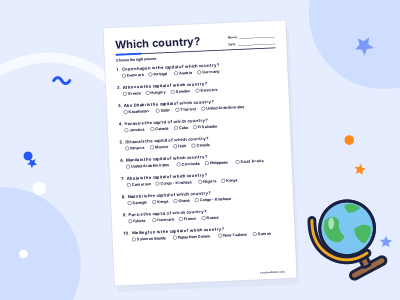
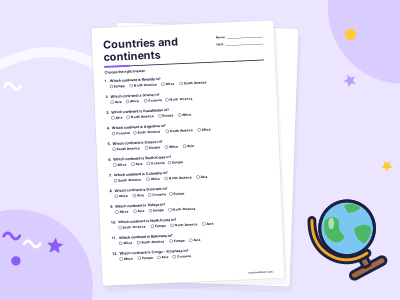
Mountains and physical geography practice
For grown-ups
Related topics
Volcanoes
A volcano is an opening in Earth's crust where hot melted rock, gases and ash escape. Over time the cooled lava and ash can build a mountain.
Earthquakes
An earthquake is a sudden shaking of the ground. It happens when rocks along a crack in Earth's crust, called a fault, suddenly slip past each other.
Rocks
Rocks are natural solids made of minerals. The three types are igneous (cooled melted rock), sedimentary (squashed layers of bits) and metamorphic (changed by heat and pressure).
Rivers
A river is a large stream of fresh water that flows downhill from its source, often in hills or mountains, to its mouth at a sea, lake or another river.
Capital cities
A capital city is the city where a country's government is based. It is not always the biggest city: Nigeria's capital is Abuja, not Lagos.
Climate
Climate is the usual pattern of weather in a place over many years, usually 30 or more. Weather is what is happening in the sky today.